
Paper: Signed MCP Tools Can Still Leak Data; Germline Execution Proposed
A research team led by Yichiet Aun of Universiti Tunku Abdul Rahman posted a paper to arXiv on 4 November 2026. It argues that confirming who published an AI agent’s tool does not prove the tool is safe. The authors present a signed Model Context Protocol (MCP) tool that leaks confidential data. They also propose a defence called germline execution.
What the paper reports
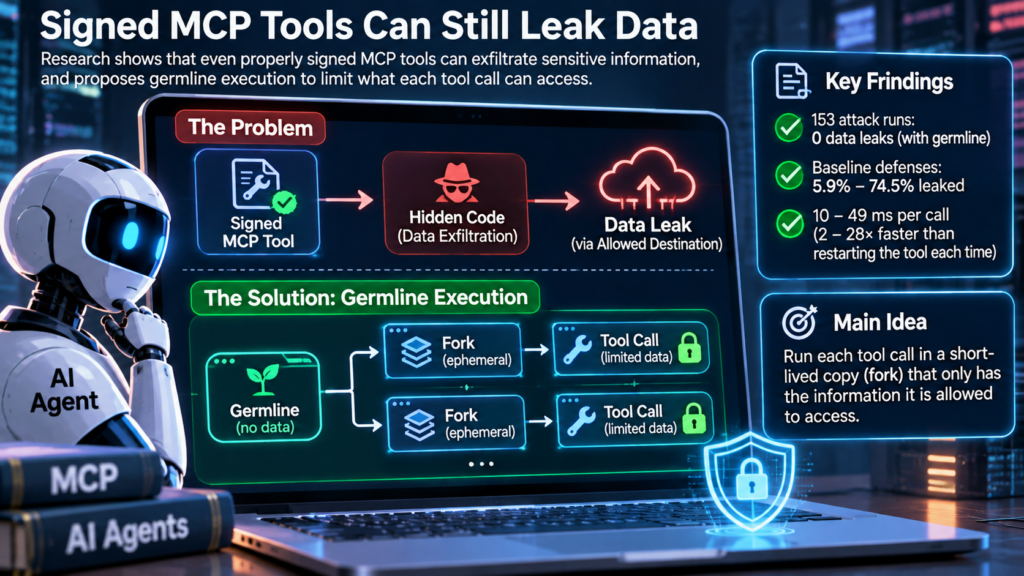
The paper starts from a common arrangement. Agents depend on third-party tools such as MCP servers. Publishers can be authenticated, and runtime security policies can restrict what the tools do. The authors say this falls short, because a properly signed tool can carry out its advertised function while secretly containing malicious code that leaks confidential information.
As a demonstration, they built a signed MCP tool that tucks sensitive data into requests sent to a destination the policy permits. They tested it against Meta’s MCPGuard-Dynamic, which they call a state-of-the-art runtime defence. In the same run, that defence stopped a direct exfiltration attempt. Against the signed tool’s attack, it failed to prevent the leak in every trial.
How germline execution works
The proposed method neither examines tool code nor relies on it. Every tool invocation executes in a short-lived copy forked from a “germline” process that contains no data. Each copy is given only the information cleared for the destination it will contact. Even if malicious code runs, the most it can reveal is whatever its own copy holds.
The authors make formal claims under stated assumptions: copies are confined, and the germline process holds no data. Given those, they prove sink noninterference for every signed release. For releases that behave deterministically within their replay model, they say a verified witness establishes that a flow violation took place.
Results
- In 153 attack runs, germline execution showed no detected unauthorised disclosure.
- Under baseline defences and an ablation, disclosure occurred in between 5.9% and 74.5% of runs.
- When a single copy served the invocations, they completed in 10-49 ms. The authors report this as 2-28 times faster than restarting the tool on every invocation, which they describe as the conventional way to clear state.
Why it matters for agents
This section is analysis, not a claim from the paper. The work separates two questions that agent toolchains often merge: who produced a tool, and what data the tool can reach. If the results hold up, a signature check alone would be a thin basis for letting a tool near sensitive context. Controlling which data reaches each call may matter just as much.
The design also suggests a practical trade-off. Restarting a tool per call is a standard way to avoid carrying state between calls. The reported timings suggest forked copies could be quicker. These are the authors’ own measurements, and the source does not describe the test setup in detail.
Several limits apply. The guarantees rest on explicit assumptions about confinement and a germline process with no data. The witness result covers only releases that are deterministic within the authors’ replay model. Zero detected disclosures in 153 runs is an empirical observation, not proof against every possible attack. The abstract also does not say which MCP deployments were used, or which other defences were tested beyond MCPGuard-Dynamic. The paper is a preprint, and the source shows no sign of peer review.
Agent developers might treat this as a threat model more than a finished product. A destination that policy allows can still serve as a covert channel, and defences that only check whether a destination is permitted may miss it.
Sources
This article was prepared with AI assistance and reviewed by an Emerge Times editor before publication. Licensed CC BY 4.0: credit “Emerge Times (emergetimes.com)”. Usage & License. Featured images are AI-generated illustrations; any logos shown are trademarks of their owners, and Emerge Times is not affiliated with them.