
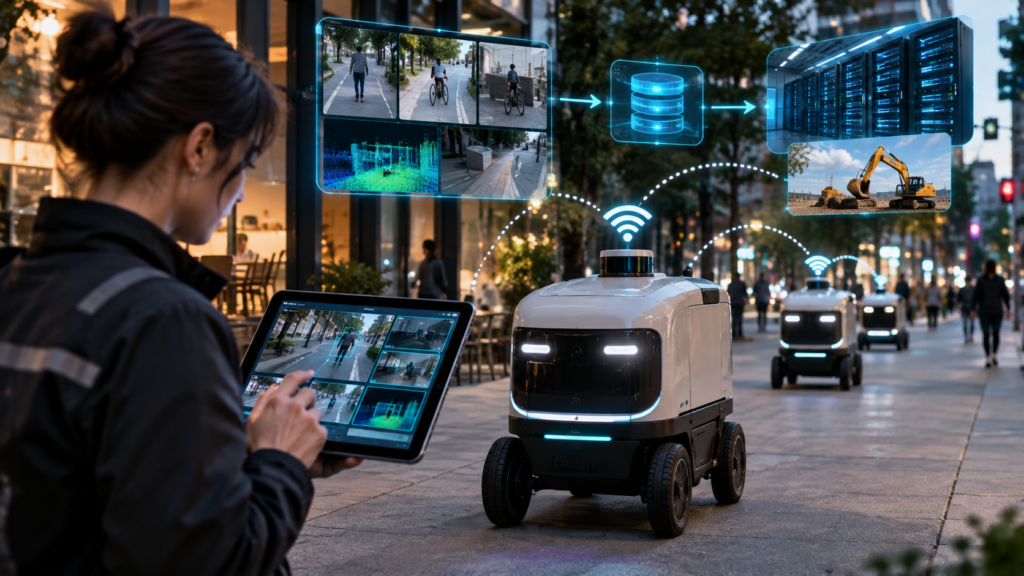
Serve Robotics Turns Its 2,000-Robot Fleet Experience Into a Physical AI Platform
The next business opportunity in robotics may extend beyond selling autonomous machines. It could involve supplying the infrastructure that allows entire robot fleets to stay connected, collect useful data, and continuously improve.
On November 5, Serve Robotics introduced Physical AI Services, opening technology developed for its autonomous delivery operations to other robotics companies.
The announcement marks a move from operating robots toward supplying infrastructure for the broader physical AI economy.
Source: Serve Robotics — Physical AI Services Announcement
From Robot Operations to AI Infrastructure
Serve says it has deployed more than 2,000 robots across over 40 cities, with additional operations in hospitals.
Operating machines in unpredictable environments generates extensive information about navigation, connectivity, obstacles, and operational failures.
The company is now commercializing technologies developed to manage those challenges.
Its new platform includes three components.
Serve Link connects robots with remote computing systems, monitoring tools, and AI models.
Serve Data Curator identifies valuable training examples within large volumes of operational data.
Serve Data Catalog provides real-world environmental information collected during sidewalk deployments.
Source: Serve Robotics — Introducing Physical AI Services
Beyond Sidewalk Delivery
Bedrock Robotics, which develops autonomous systems for heavy construction equipment, is among the platform's initial customers.
According to Serve, Bedrock uses Serve Link to connect machines through Wi-Fi, cellular networks, and satellite communications.
This illustrates how infrastructure originally developed for delivery robots could support autonomous equipment in other industries.
The Agentic Age: Intelligence Needs Infrastructure
Software agents rely on APIs, databases, and cloud services.
Physical AI agents additionally require reliable connectivity, environmental observations, operational monitoring, and continuous model improvement.
The emerging opportunity is therefore not limited to manufacturing intelligent machines.
Companies may increasingly compete to provide the infrastructure connecting physical actions with digital intelligence.
Serve's expansion suggests that experience operating autonomous fleets can become a commercial asset.
The decisive test will be whether customers achieve measurable improvements in reliability, operating costs, and autonomous task completion.
In the Agentic Age, the most valuable robotics businesses may not simply build robots.
They may build the systems that allow millions of robots to work.
Sources
- Serve Robotics — Physical AI Services Announcement, November 5, 2026
- Serve Robotics — Introducing Physical AI Services, November 5, 2026
This article was prepared with AI assistance and reviewed by an Emerge Times editor before publication. Licensed CC BY 4.0: credit “Emerge Times (emergetimes.com)”. Usage & License. Featured images are AI-generated illustrations; any logos shown are trademarks of their owners, and Emerge Times is not affiliated with them.