
How Meta’s Muse Works: A Personal AI Agent That Keeps Working After the Chat Ends
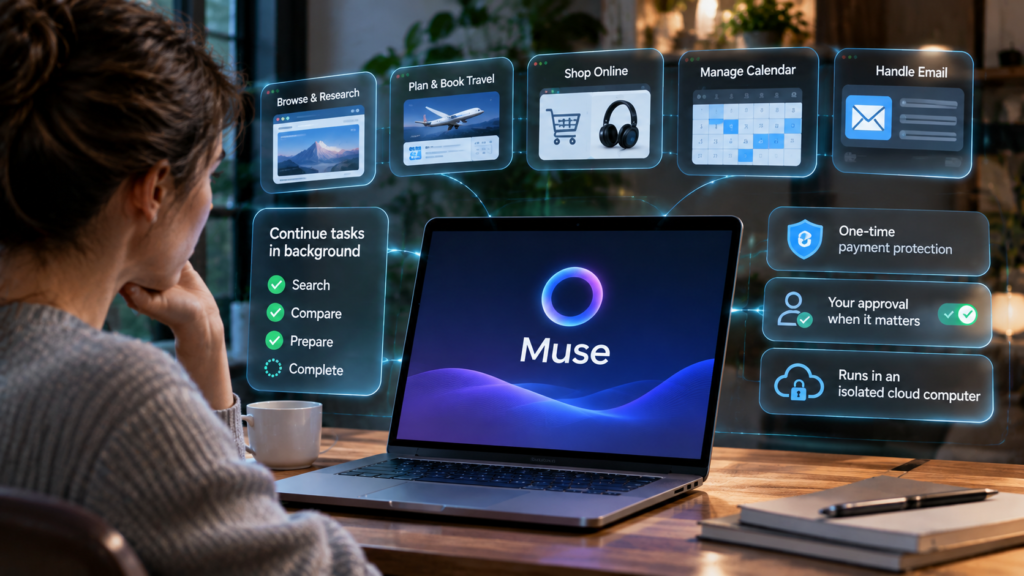
Meta is positioning its personal AI agent, Muse, as a system that does more than answer questions. It can browse websites, complete tasks across connected applications, and continue working after users close the app.
Meta introduced Muse on September 8, 2026, as part of an effort to bring autonomous AI into everyday consumer activities, from managing appointments to shopping and organizing long-term goals. This piece looks at how the agent is built and where its limits lie.
An AI Agent With Its Own Computer
Muse runs on Muse Secure VM, a dedicated cloud-based virtual machine that holds both the agent and the user's data.
Powered by Meta's Muse Spark model, the agent can open a browser, fill out forms, send email, book travel and complete checkouts.
Users communicate with Muse through its application or directly in WhatsApp.
Unlike a conventional chatbot, Muse can continue executing assigned work in the background and return when additional information or approval is required.
Source: Meta — Introducing Muse
Shopping, Payments, and Personal Goals
Meta has integrated Stripe's Link checkout service. Link's agent wallet issues a one-time-use card so the user's real card details stay hidden.
Eligible purchases receive Link's purchase protections.
Meta says Shop Pay support is coming soon and that 1Password support is planned, so Muse can use logins the user already has. It has not given dates for either.
Beyond transactions, Muse can remember details users share, make unprompted suggestions, and forget specific things when asked.
Security Built Around Autonomous Actions
Because Muse can interact with sensitive accounts, Meta developed a separate security architecture.
Each user receives an isolated virtual machine. A separate Sentinel agent decides whether actions Muse proposes, including any internet access, can proceed.
Credentials such as OAuth tokens are stored in the user's virtual machine rather than in central Meta systems. The agent works with stand-in tokens, and Sentinel swaps in the real credentials at the network boundary.
Purchases on checkout pages require the user's approval every time.
Meta also plans to introduce Muse Confidential VM, which it says is intended to cryptographically and verifiably prevent Meta from accessing data in a user's virtual machine. The company says it is sharing the design and source with external auditors.
Source: Meta AI Research — How We Built Safety Into Muse
The Agentic Age: From Conversation to Delegation
Muse illustrates a potential shift in consumer computing.
Instead of navigating applications manually, users may increasingly delegate goals to agents that coordinate software, information, and transactions.
However, Meta's descriptions do not establish independently verified success rates for complex tasks or eliminate the possibility of errors.
The critical challenge is combining useful autonomy with meaningful user control.
Muse is rolling out in the United States on iOS, Android and the web, with a free tier and paid subscriptions.
If personal agents become widely adopted, the competitive focus may move from generating convincing answers to reliably completing everyday work.
Sources
- Meta — Introducing Muse: The World's First Personal AI Agent Built for Everyone, September 8, 2026
- Meta AI Research — How We Built Safety Into Muse, September 8, 2026
- Meta — Muse Product Overview
This article was prepared with AI assistance and reviewed by an Emerge Times editor before publication. Licensed CC BY 4.0: credit “Emerge Times (emergetimes.com)”. Usage & License. Featured images are AI-generated illustrations; any logos shown are trademarks of their owners, and Emerge Times is not affiliated with them.