
GitHub outlines an agentic engineering workflow as commit volume surges
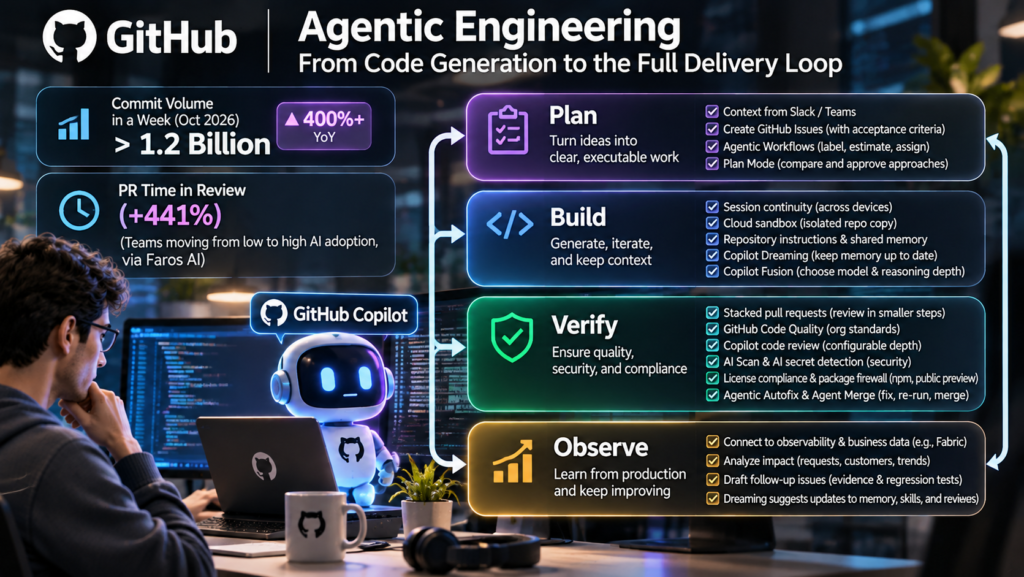
GitHub has published a developer guide on “agentic engineering” on its blog, dated 2026-11-06. It argues that faster code generation moves the bottleneck to other stages of software work. The company says it recorded more than 1.2 billion commits in a single week this October, over 400% above the same point a year earlier. It adds that this total exceeds everything GitHub received during 2025.
The problem GitHub describes
The post cites a Faros AI study. According to that study, teams that went from low to high AI adoption saw pull requests sit in review 441% longer. GitHub presents review queues as the everyday form of that number. The guide also asks developers, as a rhetorical question, whether they feel 400% more productive.
The proposed answer is to put agents to work across four stages: Plan, Build, Verify and Observe. Each stage is tied to Copilot features.
The four stages
Plan. Copilot can pull scattered context together and collaborate with teams inside Slack or Teams. It can convert agreed requirements into GitHub Issues with acceptance criteria. GitHub Agentic Workflows can label issues and estimate complexity, so simple tasks can be assigned straight to Copilot. Plan Mode lets a developer compare approaches and approve a plan before implementation begins.
Build. Session continuity allows a developer to resume a Copilot session from another device. Tasks run in cloud sandboxes, and the Copilot app gives each session its own isolated copy of the repository. Repository instructions and shared memory carry project conventions from one task to the next. A feature called Copilot Dreaming looks over eligible sessions and pull request feedback so stored memories stay up to date, and it can propose changes to instructions or skills. Copilot Fusion lets users pick models and reasoning depth, and enterprise managed settings bring company policies across Copilot surfaces.
Verify. GitHub recommends stacked pull requests so dependent work can be reviewed in smaller pieces. Other tools it names:
- GitHub Code Quality, which checks changes against organizational standards
- Copilot code review, with analysis depth set by the user or chosen by Copilot
- AI Scan and AI secret detection for security
- License compliance checks
- GitHub package firewall, which is in public preview for npm
- Agentic Autofix and Agent Merge, which handle security repairs, failing checks, review comments and merge conflicts
If configured, Copilot will merge pull requests once verification steps pass.
Observe. Through connectors such as Fabric, Copilot can reach observability tools and business data. It can help work out which requests or customer groups were affected after a release. It can also draft an issue with evidence and a regression test, and Dreaming can suggest improvements to memories, skills and code review guidance.
Why it matters for agents
The guide treats agents as participants in the whole delivery loop rather than only as code writers. Several features appear aimed at the review burden implied by the 441% figure, including stacked pull requests, automated checks and automated fixes for failing checks.
The post offers no measurements of how these tools change review time or productivity. The commit and review figures describe the problem, not the results of the proposed workflow. The benefit claims come from the vendor and are not independently tested in the source. The source also does not say which features are generally available; it labels only the package firewall as a public preview.
The design raises a delegation question for teams. Automatic merging after checks pass puts more trust in configured verification steps. Persistent memory features such as Dreaming depend on how well those steps and instructions are maintained. The source does not explain how teams should audit memory updates.
GitHub’s advice is to start small: pick one frustrating task this week, assign an agent to it, and widen the scope over time. The post notes that the topic was also presented at GitHub Universe 2026 in the session “Agentic Engineering: Past the Pilot.”
Sources
This article was prepared with AI assistance and reviewed by an Emerge Times editor before publication. Licensed CC BY 4.0: credit “Emerge Times (emergetimes.com)”. Usage & License. Featured images are AI-generated illustrations; any logos shown are trademarks of their owners, and Emerge Times is not affiliated with them.