
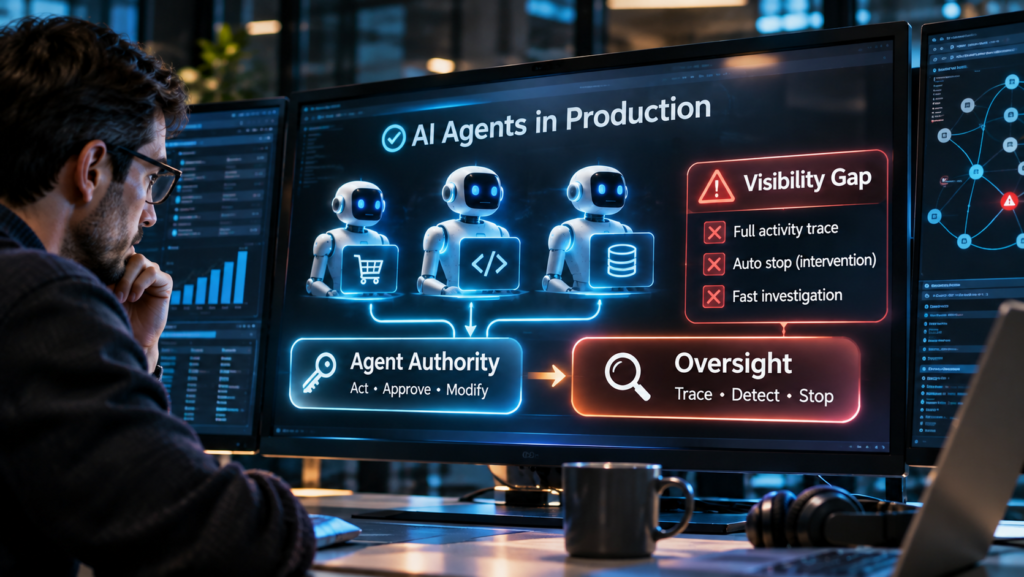
Agents Got Authority Before Oversight: Three Surveys Point to the Same Gap
Three surveys published in October 2026 asked different people different questions about AI agents at work. Read together, they describe the same imbalance: organizations are giving agents the power to act faster than they are building the ability to see, trace and stop what those agents do.
The surveys come from G2, Salt Security and Optro. Each was run by a software vendor, each relies on what respondents reported, and each drew on a different group of people. Their numbers cannot be added together or compared directly. What they share is a pattern.
AGENTS ARE IN PRODUCTION AND HOLD REAL AUTHORITY
G2's 2026 AI Agents Report, based on a survey of more than 1,000 B2B software buyers and G2 review data, found that 66% of organizations have agents in limited or scaled production. Among organizations with agents in production, 38% operate more than 100 of them.
Salt Security's "State of Agentic AI and API Security 2H 2026" report surveyed more than 380 security and technology professionals. It found that 86.4% of their organizations ran at least one AI agent, and 76.8% used agents that can chain actions across other agents, tools and APIs.
Optro surveyed 417 decision-makers in internal audit, risk, compliance and information security in North America and Europe. In its sample, 38% let agents approve or reject transactions, 34% let agents modify controls or policies, and 27% let agents change user permissions or access rights.
Sources: G2 — New G2 Research: AI Agents Have Moved From Pilot to Production. Now Comes the Distrust Tax.; Campus Technology — Unexpected AI Agent Activity Reported by Nearly Half of Organizations in Recent Survey (Salt Security report); Optro — Authority without oversight: The 2026 agentic enterprise report
THE ABILITY TO SEE AND STOP IS LAGGING
In the Salt Security survey, 12.5% of respondents said they could consistently trace an agent's complete activity, from its instructions through connected tools and APIs to the outcome. 17.5% said they could automatically stop an agent behaving unexpectedly in production. More than 60% said reconstructing an agent's previous-day activity would take hours or days of manual work.
The same survey found that 49.8% of respondents confirmed or suspected that an AI agent had taken an unintended, unexpected or unauthorized action in the past year. Among them, more than half reported unauthorized external API calls or transactions, and more than 40% reported agents modifying or deleting data.
Optro's respondents described similar events from a governance angle: 34% said their organizations had acted on an agent decision or output that turned out to be inaccurate, 30% had seen an agent take an unintended action, and 25% had experienced a control failure involving an agent. Optro also found that 96% agreed workflows should adapt to AI, while 9% had redesigned workflows to safely accommodate agents.
Sources: Campus Technology — Salt Security report coverage; Optro — Authority without oversight
THE COST SHOWS UP AS HUMAN TIME
G2 gives the cost a name: the "distrust tax," which it defines as "the ongoing cost of running agents you don't fully trust."
In G2's survey, 31% of buyers said employees spend six or more hours a week overseeing agent work, and 45% said correcting and overseeing agent mistakes consumes more than a quarter of the productivity gains they expected. 46% reported higher-than-expected operating costs, and 52% require human quality review before production.
Optro's survey, with a different group of respondents, found that 46% say employees spend more time reviewing, validating or correcting AI outputs.
Sources: G2 — 2026 AI Agents Report; Optro — Authority without oversight
EMERGE TIMES ANALYSIS: PERMISSION IS CHEAP, VISIBILITY IS NOT
Each report, on its own, reads as a familiar warning about AI risk. Side by side, they point to something more specific.
Granting an agent permission is a configuration change. Tracing what it did across tools and APIs, and stopping it automatically when it misbehaves, requires infrastructure that most of Salt Security's respondents say they do not yet have. When that infrastructure is missing, the gap does not disappear. It is filled by people: reviewers checking outputs, staff reconstructing activity by hand, teams correcting mistakes after the fact.
Seen this way, the "distrust tax" G2 describes and the visibility gap Salt Security measures may be two views of the same shortfall. The productivity that agents promise is partly being spent on the oversight their deployments did not include.
This reading has limits. The three surveys used different samples, questions and definitions, Salt Security and Optro sell or promote products related to the problems they describe, and none of the figures were independently audited. They show what respondents report, not measured incident rates.
Still, the pattern suggests where the next phase of the agent economy may be decided. Adding more agents or more authority is easy. The harder and more valuable work is making agent actions traceable, interruptible and reviewable at a cost lower than the time humans now spend watching them. Organizations that close that gap may be the ones that keep the productivity agents were supposed to deliver.
Sources
- G2 — New G2 Research: AI Agents Have Moved From Pilot to Production. Now Comes the Distrust Tax., October 14, 2026
- Campus Technology — Unexpected AI Agent Activity Reported by Nearly Half of Organizations in Recent Survey, October 21, 2026 (on Salt Security's State of Agentic AI and API Security 2H 2026 report)
- Salt Security — State of Agentic AI and API Security 2H 2026 (registration required)
- Optro — Authority without oversight: The 2026 agentic enterprise report, October 8, 2026
This article was prepared with AI assistance and reviewed by an Emerge Times editor before publication. Licensed CC BY 4.0: credit “Emerge Times (emergetimes.com)”. Usage & License. Featured images are AI-generated illustrations; any logos shown are trademarks of their owners, and Emerge Times is not affiliated with them.