
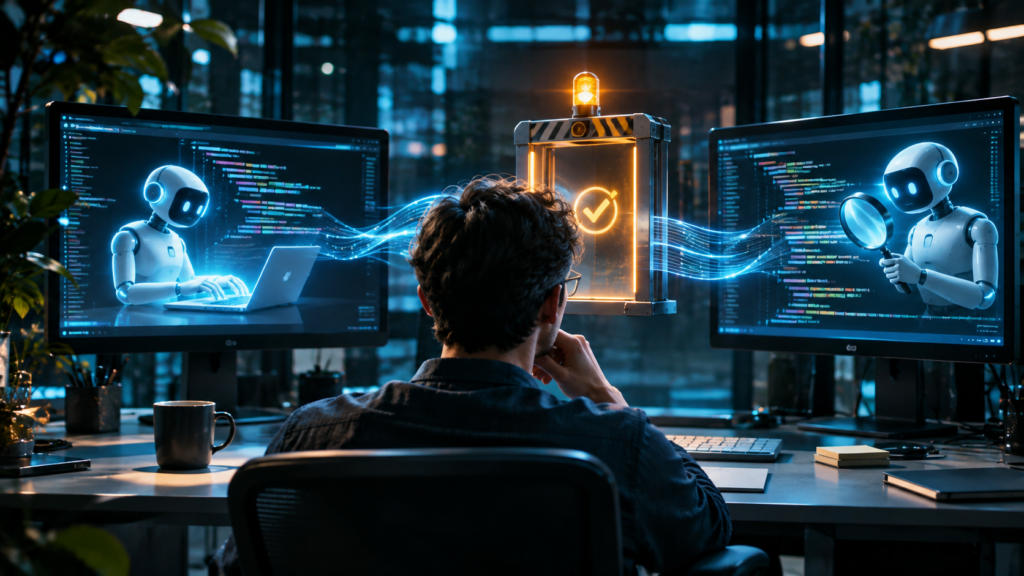
When AI Reviews AI: Is Software Engineering Creating a New Trust Bottleneck?
AI coding agents are accelerating software production. But as AI systems increasingly review code written by other AI systems, a new question emerges: who verifies the verifiers?
Two independent research efforts show different sides of this transition. Engineering telemetry shows growing pressure on code review, while an academic study documents the emergence of AI-to-AI review at scale.
The First Bottleneck: Code Review
Faros AI, which sells engineering analytics software, analyzed two years of engineering telemetry covering approximately 22,000 developers across 4,000 teams for its Q2 2026 engineering report.
Comparing periods of lower and higher AI adoption within the same organizations, the report found that higher adoption was associated with larger pull requests, more defects, and longer review cycles.
Among its findings were a 51% increase in pull request size, 28% more bugs per pull request, and a fivefold increase in median review time.
Faros describes these as statistically significant relationships, not proof that AI adoption alone caused every reported change.
Source: Faros AI — The Acceleration Whiplash (Q2 2026)
The Second Development: AI Reviewing AI
A separate academic paper, AI-to-AI Code Reviews of GitHub Pull Requests, examined 248,641 AI-attributed pull requests that received at least one AI-attributed review, using a public dataset of coding-agent activity on GitHub.
Of these, 45,269 received reviews involving different AI products, while 208,145 received reviews involving the same product. 4,773 pull requests belonged to both categories.
The researchers found that cross-product AI review occurred in approximately 1.6% of identified agent-authored pull requests. Its volume rose by more than two orders of magnitude between the first and third quarters of 2025.
The authors concluded that closed-loop AI-to-AI review is increasing but remains a minority of identified agent activity. The study measured review activity, not whether those reviews improved software reliability.
Source: Selvanayagam and Ghaleb — AI-to-AI Code Reviews of GitHub Pull Requests
Emerge Times Analysis: From Review Bottlenecks to Trust Bottlenecks
Connecting these findings suggests a possible shift in software engineering.
When humans review AI-generated code, human attention can limit throughput. Faros' data points to that pressure: larger changes, more defects, and longer review times.
When AI reviews AI-generated code, that immediate constraint may diminish. The arXiv study shows this is already happening. But another challenge appears: whether automated reviewers can reliably identify errors introduced by automated authors.
Using different AI products does not necessarily guarantee independent judgments. Systems may share training patterns, assumptions, or failure modes.
Neither study directly tests this hypothesis.
The critical distinction is between completing a review and demonstrating that the review was effective.
What Should Be Measured Next?
Future studies could compare human-only, AI-only, and hybrid review workflows using independently seeded defects.
Useful measurements would include escaped defects, false approvals, correction time, review costs, and production incidents.
A particularly important question is whether independent reviewers reduce correlated errors.
The Agentic Age may not eliminate software engineering's verification bottleneck. It may relocate it, from the availability of human reviewers to the reliability of automated judgment.
That possibility deserves measurement before organizations treat AI-to-AI review as equivalent to independent assurance.
Sources
- Faros AI — The Acceleration Whiplash, Engineering Report Q2 2026
- Niruthiha Selvanayagam and Taher A. Ghaleb — AI-to-AI Code Reviews of GitHub Pull Requests, arXiv, August 21, 2026
This article was prepared with AI assistance and reviewed by an Emerge Times editor before publication. Licensed CC BY 4.0: credit “Emerge Times (emergetimes.com)”. Usage & License. Featured images are AI-generated illustrations; any logos shown are trademarks of their owners, and Emerge Times is not affiliated with them.