
AI Seabed Robot Retrieves Minerals at 4,000 Meters. Environmental Proof Remains Missing.
An autonomous underwater robot has reportedly collected mineral-rich rocks from the Pacific seabed at depths exceeding 4,000 meters. The test by Impossible Metals demonstrates progress in robotic mineral recovery, but it leaves a larger question unresolved: can selective AI collection operate at commercial scale without unacceptable environmental damage?
A ROBOTIC COLLECTION TEST
On November 10, Reuters reported that Impossible Metals had successfully tested an AI-powered seabed mining robot during a scientific expedition in September.
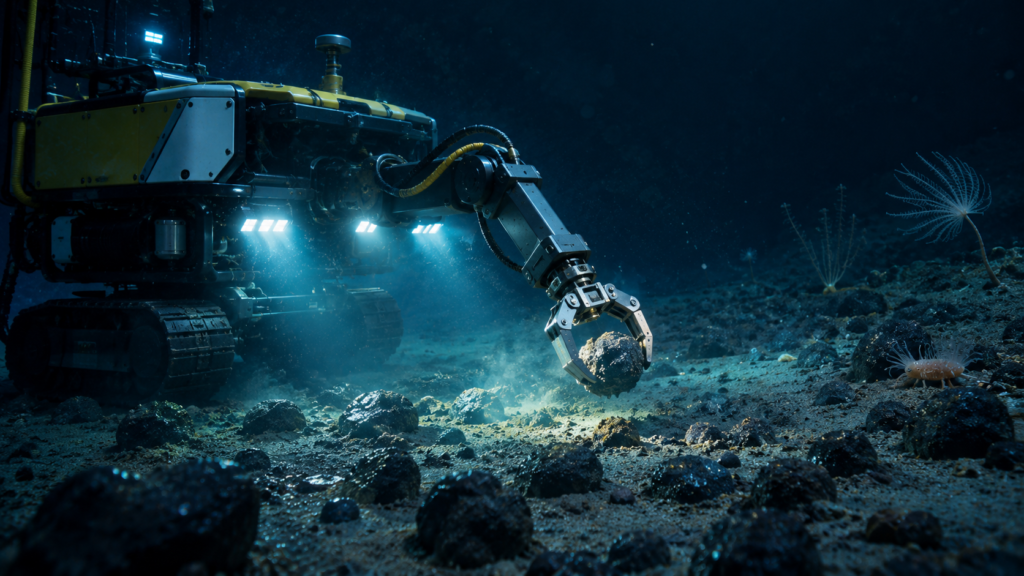
According to the company, the robot descended more than 4,000 meters to the Pacific seabed, collected approximately 450 grams of polymetallic nodules using a large claw, and returned to the surface.
The company says its system uses artificial intelligence to avoid aquatic life and reduce environmental impacts. Unlike vacuum-like collection devices used by some other developers, its approach uses robotic manipulation to retrieve selected objects.
However, the reported experiment demonstrates limited sample recovery, not sustained commercial production or independently verified environmental protection.
FROM EXPERIMENT TO COMMERCIAL OPERATION
Impossible Metals has also pursued potential commercial partnerships.
In July, Deep Sea Minerals Corp. announced a memorandum of understanding with Impossible Metals to evaluate its autonomous robotic nodule-collection technology.
The agreement is exploratory. It does not establish an operating mine or a regulatory authorization.
According to Reuters, the company still needs regulatory approval before commercial operations.
Source: Deep Sea Minerals Corp. — MOU with Impossible Metals, July 6, 2026
EMERGE TIMES ANALYSIS: AUTONOMY DOES NOT ESTABLISH SUSTAINABILITY
This experiment exposes a distinction increasingly relevant to physical AI.
A robot can successfully recognize, approach and collect an object without proving that its activity is environmentally acceptable.
Selective collection could potentially reduce some forms of disturbance. Yet validating that advantage requires independent measurements of sediment disruption, habitat effects, species detection failures and cumulative ecological consequences.
Commercial feasibility also depends on collection rates, energy consumption, maintenance, recovery costs and regulatory approval.
A 450-gram sample cannot establish those economics.
The next meaningful benchmark is therefore not simply whether AI can recover minerals from extreme depths.
It is whether autonomous systems can document what they collected, what they avoided, what they disturbed and how reliably those observations can be verified.
In the Agentic Age, physical autonomy will increasingly encounter a second test: accountability for the environments in which machines act.
Sources
- Reuters, via Kitco — Impossible Metals Says It Has Successfully Tested AI Seabed Mining Robot, November 10, 2026
- Deep Sea Minerals Corp. — MOU with Impossible Metals, July 6, 2026
Editorial Note:
The reported collection results originate from company statements covered by Reuters and have not been independently audited.
This article was prepared with AI assistance and reviewed by an Emerge Times editor before publication. Licensed CC BY 4.0: credit “Emerge Times (emergetimes.com)”. Usage & License. Featured images are AI-generated illustrations; any logos shown are trademarks of their owners, and Emerge Times is not affiliated with them.