
OpenAI’s Daybreak puts AI agents into security testing and patching
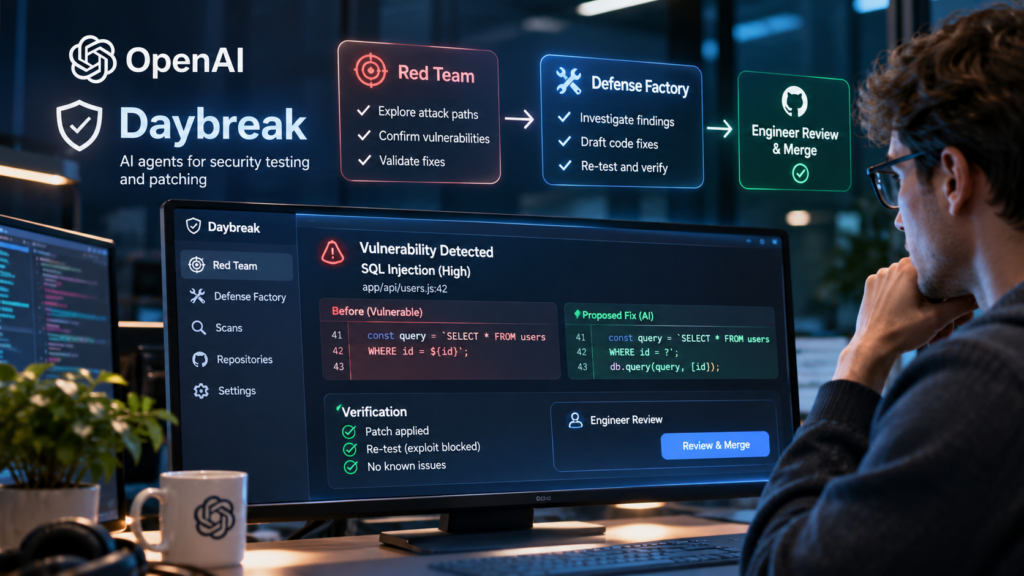
OpenAI is applying AI agents to more of the software security workflow with Daybreak, according to a Help Net Security report dated 13 November 2026. Daybreak has two offerings, Red Team and Defense Factory. Red Team does web application penetration testing. Defense Factory investigates vulnerabilities and prepares fixes. Together they link the discovery of weaknesses to patching and retesting.
Red Team: testing and verifying fixes
Daybreak Red Team is offered through an early-access program. Coordinated agents read an application’s source code and context, explore possible attack paths and confirm whether vulnerabilities are real. The tool can also validate results that originate from code scanners, from bug bounty reports and from vulnerability disclosure reports. The stated purpose is to hand security teams evidence they can use to decide which repairs come first.
After a fix has been written, Red Team can run a check on whether it actually blocks the exploit. OpenAI says assessments stay inside defined limits. It names isolated environments and Guardian review as the controls over which applications and endpoints the agents may reach.
Defense Factory: from finding to patch
Defense Factory covers remediation. Its agents take findings from existing security tools or from Red Team, follow each vulnerability through the code and draft proposed fixes. Engineers review and test the patches before merging them. Codex lets teams inspect the evidence, add context and refine the changes.
Setup happens in ChatGPT. Teams with access install and enable the Daybreak Defense Factory (Preview) plugin, then link a GitHub repository. Scans in the cloud run on Codex cloud, and anyone who launches a scan must have their own personal GitHub connection. A scan can cover the whole default branch of a repository or selected folders and files.
Teams have further options:
- watching the default branch for new commits;
- setting recurring scans of that branch on a schedule;
- enabling security review of pull requests ahead of merging.
The desktop app additionally scans local checkouts and uncommitted changes. It has an optional Deep scan mode that makes multiple passes and spends more time and tokens.
Why it matters for agents
This section is analysis, not part of the source report. Daybreak shows agents chained across a workflow: one stage confirms a problem, and the next proposes and tests a fix. Validated evidence could help security teams sort through large volumes of scanner output and reports. The source gives no data on accuracy, speed or false-positive rates, so any benefit is unproven here.
Human oversight is part of the design. Engineers review and test patches before merging, and agent access is bounded by isolated environments and review. How well those limits work in practice is unclear, since the source relies on OpenAI’s own description. Teams considering such tools may want to ask how agent reach is scoped, who is accountable for a merged AI-drafted patch, and what extra cost deeper scans bring in time and tokens.
The source does not say when Red Team access will widen. It also gives no pricing and no full list of supported languages and tools.
Sources
- OpenAI’s Daybreak brings AI agents to security testing and vulnerability fixes — helpnetsecurity.com
This article was prepared with AI assistance and reviewed by an Emerge Times editor before publication. Licensed CC BY 4.0: credit “Emerge Times (emergetimes.com)”. Usage & License. Featured images are AI-generated illustrations; any logos shown are trademarks of their owners, and Emerge Times is not affiliated with them.