
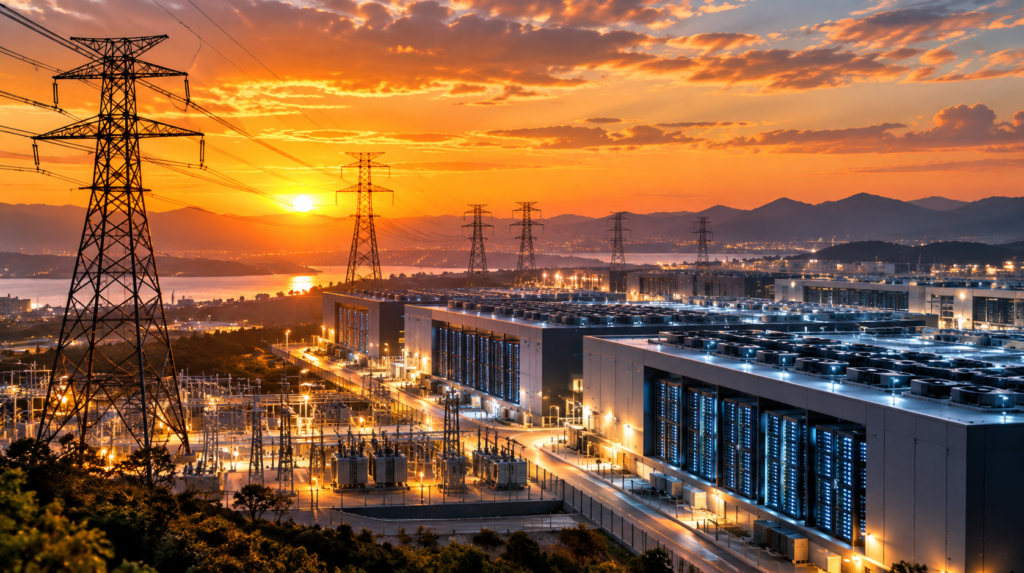
The Next AI Bottleneck May Not Be Chips. It May Be Electricity.
For much of the AI boom, the world has focused on one bottleneck: chips.
Advanced GPUs became scarce, semiconductor supply chains became strategic assets, and companies raced to secure computing power. But as artificial intelligence infrastructure expands, another constraint is becoming harder to ignore.
Electricity.
AI does not run in the cloud in any physical sense. It runs inside enormous data centers filled with servers that consume electricity, generate heat and require extensive cooling. As companies build larger AI systems and deploy them to millions of users, the amount of physical infrastructure behind artificial intelligence is growing rapidly.
That is beginning to change the geography of the AI economy.
The New Constraint
Building an AI data center requires more than land and servers. Operators need reliable access to large amounts of electricity, transmission infrastructure, cooling capacity and connections to the wider power grid.
In some regions, those requirements can be harder to secure than the computing equipment itself.
A company may be able to purchase thousands of advanced chips, but those chips are useless without enough electricity to operate them. New power generation and transmission infrastructure can also take years to plan and build.
That creates an unusual mismatch.
AI technology can improve in months. Electrical infrastructure often develops over years or decades.
As AI computing demand grows, that difference in speed could become one of the industry’s most important constraints.
AI Is Becoming an Energy Business
This shift could change how technology companies think about expansion.
For decades, software companies could scale globally without building much physical infrastructure themselves. AI is different. Training and operating large models requires increasingly industrial-scale facilities.
That means technology companies are becoming more closely connected to energy markets, utilities, power producers and governments.
The most valuable locations for future AI infrastructure may therefore not simply be traditional technology hubs.
Regions with abundant electricity, available land, strong grid connections and political support for new infrastructure could become increasingly attractive.
This creates opportunities for places that previously played only a small role in the global technology industry.
A New Geography of Computing
The consequences may extend far beyond data centers.
If AI infrastructure moves toward regions with cheaper or more abundant energy, investment could follow. New transmission lines, substations, renewable-energy projects, gas generation, nuclear power and energy-storage systems may all become part of the AI infrastructure race.
Communities near these projects could experience rising demand for land, construction workers, engineers and supporting businesses.
At the same time, competition for electricity could create political tensions. Residents and existing industries may question whether rapidly expanding data centers should receive priority access to limited grid capacity.
The AI boom could therefore become not only a technology story, but also an energy and infrastructure story.
Beyond the Chip Race
Semiconductors will remain critical. The race for faster and more efficient chips is far from over.
But the next phase of AI may increasingly depend on something much older than artificial intelligence itself: the power grid.
The countries and regions that can generate electricity, move it efficiently and connect new computing facilities quickly may gain an unexpected advantage in the AI economy.
The first phase of the AI boom was defined by the race for chips.
The next may be defined by the race for power.