
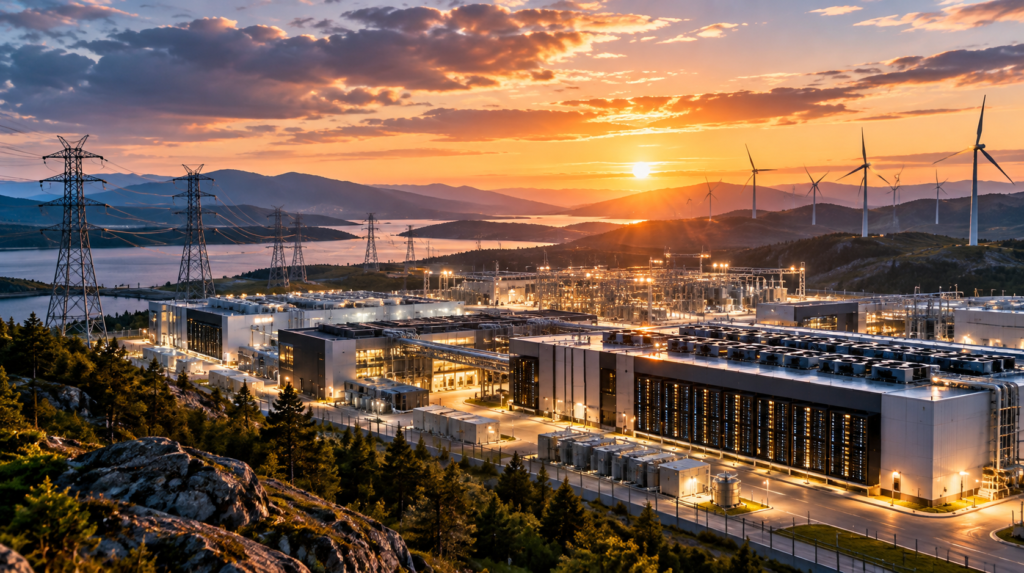
AI Is Starting to Change Where the World Builds Its Power
Artificial intelligence is beginning to reshape more than software. It is starting to influence where the physical infrastructure of the digital economy gets built.
The reason is simple: AI requires enormous amounts of computing power, and computing power requires electricity.
As companies race to build larger data centers for training and running AI models, access to reliable and affordable power is becoming one of the most important factors determining where new infrastructure can be located.
For decades, technology companies tended to cluster around major cities and established technology hubs. Talent, universities, venture capital and communications networks were the dominant considerations.
AI is changing that equation.
A large AI data center does not necessarily need to sit next to millions of consumers. What it needs is electricity, land, cooling capacity, fiber connectivity and a grid capable of supporting very large loads.
That creates opportunities for places that previously sat far outside the center of the technology economy.
Regions with abundant renewable energy, available industrial land or underused power infrastructure may suddenly become strategically important. Rural areas near hydroelectric facilities, wind farms, solar generation or major transmission lines could attract investment that once would have seemed unlikely.
This shift may also change the economics of energy itself.
When a new data center arrives, it can become one of the largest electricity consumers in an entire region. Utilities may need to expand substations, transmission networks and generation capacity. Governments may compete to attract projects while also confronting questions about electricity prices, water use and local environmental impact.
The result is a new relationship between artificial intelligence and geography.
The AI economy may be digital, but the infrastructure supporting it is intensely physical.
Servers need buildings. Buildings need land. Chips need cooling. And almost everything ultimately depends on electricity.
That means some of the most important locations in the next phase of the AI boom may not be traditional technology capitals at all.
They may be places where energy, land and infrastructure happen to intersect.
If that trend continues, AI could quietly redraw the economic map — creating new infrastructure corridors, changing the value of previously overlooked locations and bringing technology investment to regions that were never considered part of the global tech industry.
The geography of the internet was shaped by networks.
The geography of artificial intelligence may increasingly be shaped by power.