
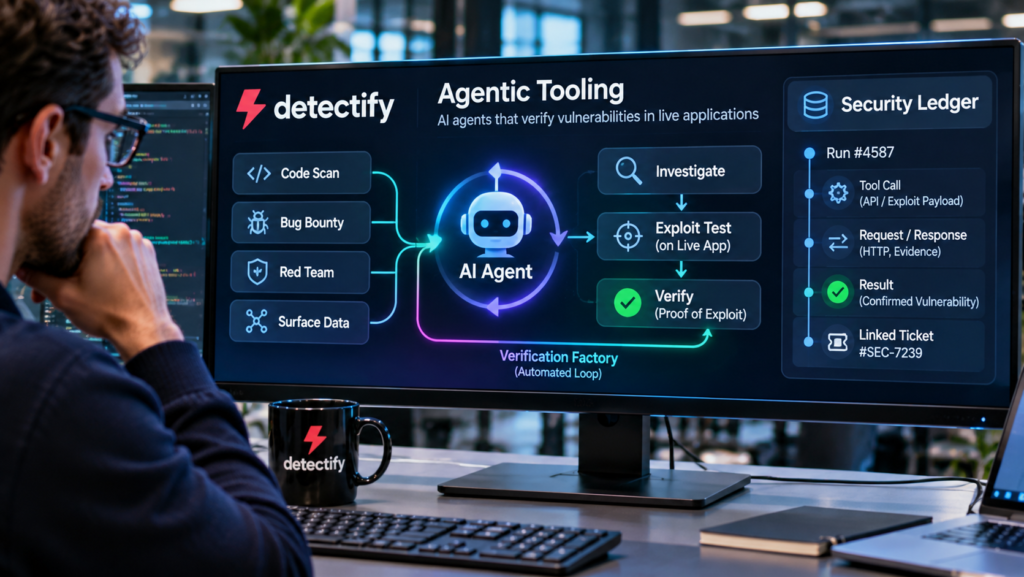
Detectify launches Agentic Tooling so customer AI agents can verify vulnerabilities
Security vendor Detectify has released Agentic Tooling, which allows an organization’s own AI agents to look into suspected security flaws and try to prove whether they are actually exploitable in applications that are running. The launch was reported on 17 November 2026. A second component, the Security Ledger, lets security teams compare what agents claim against recorded evidence.
What the product does
The tooling hands agents access to testing engines that Detectify says it has developed over more than ten years. Those draw on attack payloads contributed by the company’s community of ethical hackers, on its Alfred AI, and on its Surface Monitoring data. Everything runs inside the customer’s own environment via MCP and a CLI, with the customer’s own agents and models, and only on data the customer supplies.
Detectify describes the design as suited to “loop engineering”, meaning agents run in repeating, automated workflows instead of being prompted by a person at every stage. A continuous integration run or a scheduled job kicks off the cycle. Results from code scanning, bug bounty submissions, red-team exercises and Detectify’s attack surface data are each turned into a ticket. An agent takes a ticket, reads the related code, and then probes the deployed application externally, taking the position of an attacker, to see whether the flaw can really be abused. One pass carries a single finding from start to proof before the agent moves to the next. Detectify calls the always-on version a “verification factory”, set against the software factory that produces the code.
The Security Ledger
Each time an agent calls Detectify’s tools, the ledger logs what was tested: which requests went out, which payloads were tried and what came back. It links that evidence to the ticket that started the work, giving an engineer a single timeline of the agent’s actions, its conclusions and the support for them. According to Detectify, the Detectify tools write the ledger, not the agent, and entries can only be appended. The company says this lets teams separate findings grounded in real tests from AI-generated conclusions with no support.
“We’re building proof that an agent can’t fabricate,” said Rickard Carlsson, Detectify’s CEO.
The problem Detectify describes
The company says AI is writing a growing portion of code, and that flaws travel down the same fast pipelines. It reports that its customers estimate about 80% of the output from their AI-based SAST tools is noise, and it warns that agents can produce a persuasive write-up of a test they never carried out.
Detectify also points to outside and internal figures. Its H2 2026 Cyber Hygiene Index found that 90% of open critical and high-severity vulnerabilities had stayed unresolved and exposed for over 90 days. A 2026 study from Fudan University and Tencent researchers reported that 76% of the static-analysis alerts it reviewed were false positives, and that developers spent 10 to 20 minutes on each alert.
The new product extends the Detectify MCP Server, which came out in May 2026 and gave agents access to the company’s findings and scanning functions. Detectify intends to supply the loop with data from elsewhere on its platform; one example it gives is a newly opened port automatically prompting an agent to investigate. The source gives no pricing or availability details.
Why it matters for agents
The product reflects a pattern that could spread beyond security: the agent does the reasoning, while a separate system generates the evidence. Since the tools, not the agent, write the ledger, a reviewer need not rely on the agent’s own description of its work. That targets the fabrication risk Detectify raises, although the source includes no independent testing of how well it works.
It also shows agent workflows being attached to existing work queues. Tickets serve as both the trigger and the record, and customers retain control over models and data. Teams adopting this approach would still have to decide who examines the ledger and how much exploit testing against live applications they are willing to automate. The source does not cover those governance questions. The noise and false-positive numbers come from Detectify’s customers and a cited study, and the source does not show whether this tooling lowers them.
Sources
- Detectify launches Agentic Tooling to verify vulnerabilities in live applications — helpnetsecurity.com
This article was prepared with AI assistance and reviewed by an Emerge Times editor before publication. Licensed CC BY 4.0: credit “Emerge Times (emergetimes.com)”. Usage & License. Featured images are AI-generated illustrations; any logos shown are trademarks of their owners, and Emerge Times is not affiliated with them.