
DHL’s 9,000 Robots Point to the Next Challenge: AI-Orchestrated Warehouses
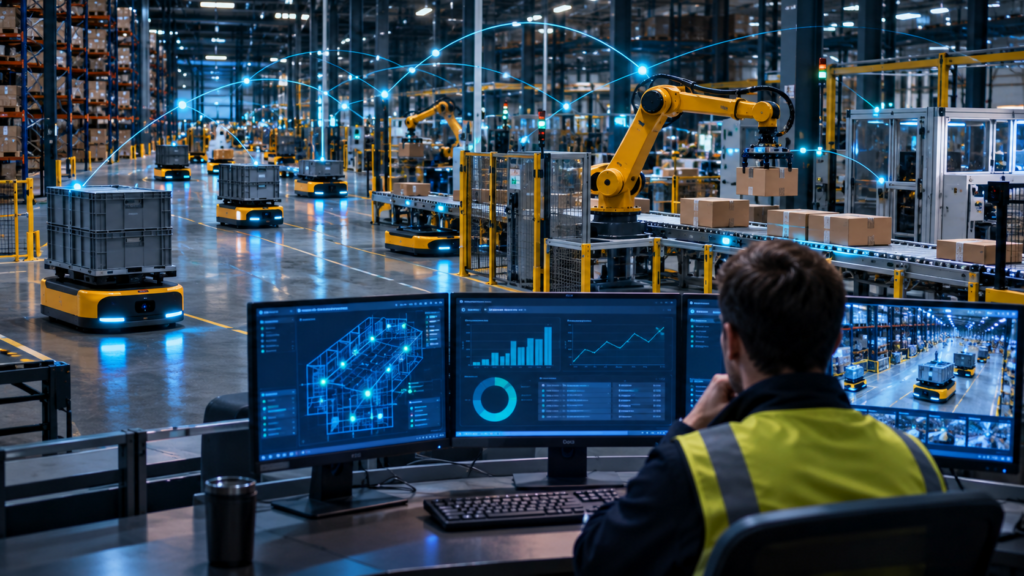
The next stage of warehouse automation may depend less on deploying additional robots than on coordinating the machines already operating. DHL Supply Chain's announcement this month highlights that transition, combining established robotics deployments with new work on adaptive AI orchestration.
FROM AUTOMATION TO COORDINATION
DHL reports deploying more than 9,000 robots across its global network, completing over 1.5 billion robotic picks and reaching 10 million case unloads using Boston Dynamics' Stretch robot.
The company also reports more than 2.5 million minutes of conversational AI agent interactions. Advanced digitalization solutions are installed in over 95% of its global warehouses.
These figures describe different technologies and activities. They do not mean that all 9,000 robots operate autonomously under a single AI system.
DHL is piloting adaptive robots and AI orchestration software that links employees, automated equipment and operational data. One application connects autonomous mobile robots, packaging automation and a warehouse management system so that resources can be reallocated as order volumes change.
The objective is to allocate resources dynamically as order demand changes, rather than relying exclusively on fixed automation sequences.
Source: DHL Supply Chain, November 2026
HUMANOID ROBOTS ENTER THE SAME EXPERIMENT
A separate announcement from GXO Logistics and Apptronik provides another indication of the industry's direction.
The companies signed a letter of intent to expand live-warehouse trials of Apptronik's Apollo humanoid robot from 2027, covering picking, case and tote movement, packing and sortation. Subject to meeting agreed performance, safety and operational targets, they intend to progress toward a rollout of up to 1,000 Apollo robots over four years, under an expected Robotics-as-a-Service model.
The agreement signals interest in flexible physical automation, but it is a conditional plan, not evidence of a completed large-scale humanoid rollout.
Both developments show logistics operators exploring systems that can adapt to changing work rather than execute only predefined tasks.
EMERGE TIMES ANALYSIS: THE WAREHOUSE AS A MULTI-AGENT SYSTEM
The economic question is shifting from what an individual robot can accomplish to how effectively an entire warehouse coordinates its resources.
A mobile robot, packing station, inventory system and human supervisor each possess different capabilities and constraints.
An orchestration layer could continuously assign work based on demand, congestion, machine availability and operational priorities.
But adaptive coordination also introduces new failure modes. A mistaken allocation decision can disrupt several connected systems simultaneously.
Neither announcement provides independently audited results demonstrating improved warehouse-wide throughput, reduced labor costs or lower error rates from the new orchestration approaches.
The next meaningful benchmark should measure completed orders per hour, intervention rates, recovery from disruptions and total operating cost.
In the Agentic Age, the most valuable intelligence may not reside inside any single machine. It may emerge from coordinating many machines and people into a reliable operational system.
Sources
- DHL Supply Chain — Doubles Down on Digitalization Strategy, Pilots Adaptive Robotics and AI Orchestration, November 2026
- Robotics 24/7 — GXO, Apptronik Scale Humanoid Robot Deployments as Partnership Expands, November 2026
Editorial Note: Deployment figures are company-reported. The adaptive orchestration and humanoid expansion initiatives remain subject to operational validation.
This article was prepared with AI assistance and reviewed by an Emerge Times editor before publication. Licensed CC BY 4.0: credit “Emerge Times (emergetimes.com)”. Usage & License. Featured images are AI-generated illustrations; any logos shown are trademarks of their owners, and Emerge Times is not affiliated with them.