
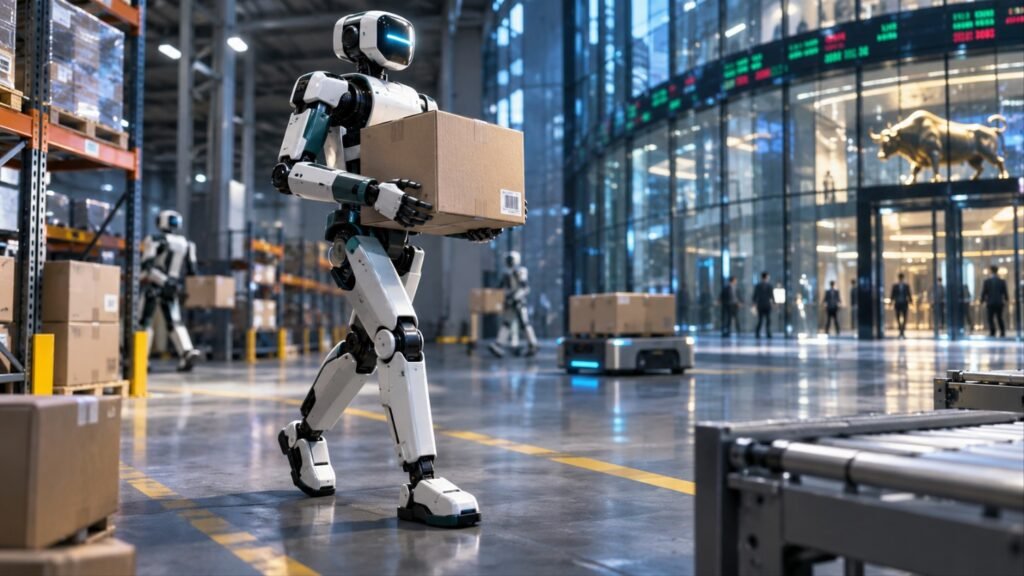
Humanoid Robots Enter the Capital Markets — Agility Robotics Targets Nasdaq
Humanoid robotics is approaching a new milestone. Agility Robotics, developer of the Digit humanoid robot, is preparing to enter the public markets through a proposed business combination with Churchill Capital Corp XI.
The development signals a broader shift in Physical AI: humanoid robots are moving beyond technological demonstrations toward businesses that investors can evaluate through financial performance, deployment economics, and commercial demand.
A $465 Million Capital Raise
On October 30, Agility Robotics announced that its expected gross capital raise associated with the proposed transaction had reached approximately $465 million, before transaction expenses.
The business combination is expected to close on November 4, subject to shareholder approval and other closing conditions.
If completed as planned, the combined company is expected to begin trading on Nasdaq under the ticker AGLT on November 5.
These dates remain anticipated milestones, not completed events.
Source: Agility Robotics, October 30, 2026
From Robotics Research to Industrial Economics
Agility Robotics develops Digit, a humanoid robot designed for physical work in environments such as warehouses and logistics facilities.
Unlike conventional industrial robots operating in highly structured production cells, humanoid robots are being developed to perform tasks in spaces originally designed for human workers.
Their commercial success will depend on more than walking ability or impressive demonstrations.
Customers will need measurable productivity, reliable operation, manageable maintenance costs, and clear economic advantages.
Public-market scrutiny could bring greater attention to these practical requirements.
Emerge Times Analysis: Physical AI Meets the Agent Economy
The Agent Economy is often described as a digital ecosystem where autonomous software agents access tools, information, and computing services.
Humanoid robotics introduces another dimension: autonomous systems performing physical work.
A future industrial agent could coordinate warehouse operations, allocate tasks to robots, monitor equipment, and verify completed activities.
This would connect digital decision-making with physical execution.
The economic implications could extend across robotics hardware, AI software, maintenance services, fleet management, and industrial automation.
However, the transition remains uncertain. Capital availability does not guarantee successful deployment, profitability, or broad customer adoption.
The Bigger Picture
Agility Robotics' proposed public-market debut represents more than a financing event.
It highlights an emerging question for the robotics industry: can humanoid machines become economically sustainable workers rather than expensive technological experiments?
As AI moves from digital tasks into physical environments, the next phase of the Agentic Age may increasingly be measured not by demonstrations, but by productive work.
The future of Physical AI will be decided not only by what robots can do, but by the economic value they can reliably deliver.
Sources
Agility Robotics and Churchill Capital Corp XI — Official Transaction Update, October 30, 2026
Unite.AI — Agility Robotics Expects $465M Gross Capital Raise, October 30, 2026
This article was prepared with AI assistance and reviewed by an Emerge Times editor before publication. Licensed CC BY 4.0: credit “Emerge Times (emergetimes.com)”. Usage & License