
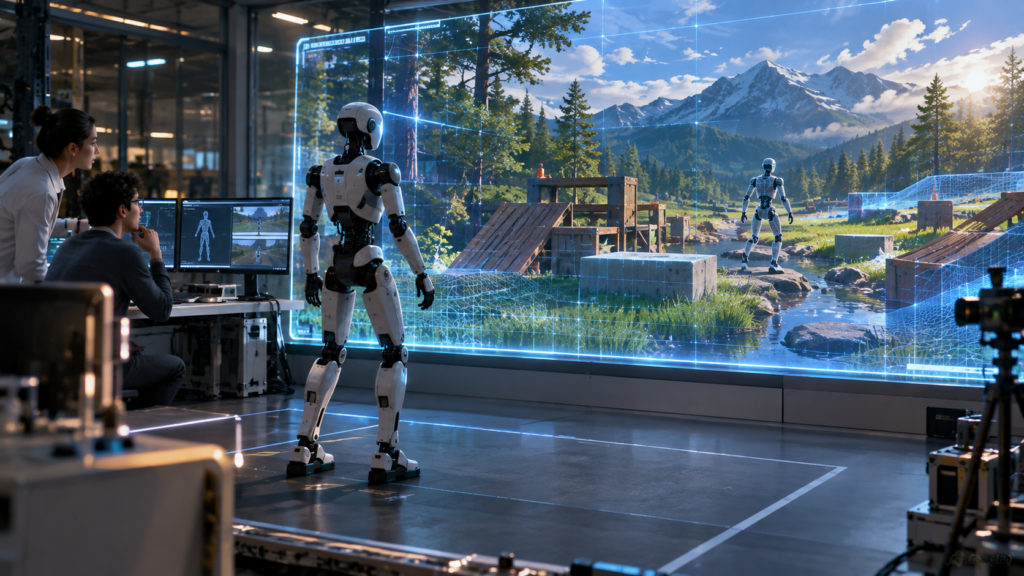
Google’s Genie 4 Opens a New Frontier: AI Agents Learning Inside Simulated Worlds
Artificial intelligence is approaching a new frontier: learning through experience inside worlds generated by AI itself.
On October 27, Google DeepMind introduced Genie 4, a world model capable of generating interactive environments with realistic visuals, sound, and responsive behavior.
Unlike conventional AI video generators, Genie 4 allows users to explore and modify simulated environments in real time.
The development could have significant implications for robotics, autonomous agents, and the future Agent Economy.
A World That Responds to AI
Genie 4 generates environments that respond to movement, natural-language instructions, and changing conditions.
Users can introduce objects, alter weather, or modify scenes while the simulation continues.
The system combines several Gemini models, including Gemini Omni and Gemini 3.8 Flash.
Gemini 3.8 Flash acts as a guiding agent, observing simulated environments, planning actions, and monitoring their outcomes.
Google also demonstrated research combining Genie 4 with Gemini 4 Argon to simulate robotic activities.
Source: Google DeepMind — Genie 4 Announcement
Why This Matters for Robotics
Training robots in physical environments is expensive, time-consuming, and potentially dangerous.
Simulated worlds could allow AI systems to practice unfamiliar situations before encountering them in reality.
A warehouse robot, for example, might eventually rehearse navigating obstacles, handling unexpected objects, or coordinating with other machines inside generated environments.
However, Google has not established that Genie 4 can reliably replace conventional robotics simulators or real-world training.
The technology remains experimental.
Source: Google DeepMind — Genie 4 Model Overview
Emerge Times Analysis: The Rise of Synthetic Experience
The deeper significance of Genie 4 is the possibility of creating experience itself as a computational resource.
Today's AI agents primarily learn from existing data and interact with external tools.
Future agents may increasingly learn by exploring simulated environments, testing decisions, and observing consequences.
This could create a new infrastructure market built around synthetic environments, agent training, simulation verification, and physical-world adaptation.
Instead of purchasing only computing power or model intelligence, developers could eventually purchase simulated experiences designed for specific tasks.
But important limitations remain.
Genie 4 currently supports only a few minutes of continuous interaction. Visual consistency, complex multi-agent behavior, and accurate physical simulation remain research challenges.
Independent evaluations are also limited.
Source: The Frontier — Genie 4 Technical Analysis
The Bigger Picture
The Agentic Age may require more than intelligent models and execution infrastructure.
It may also require environments where AI systems can safely experiment, make mistakes, and improve.
Genie 4 offers an early glimpse of that possibility.
The next generation of AI agents may learn not only from information, but from experiences created by other AI systems.
Sources
- Google DeepMind — Genie 4, October 27, 2026
- Google DeepMind — Genie 4 Model Overview
- The Frontier — Genie 4 Analysis, October 28, 2026
This article was prepared with AI assistance and reviewed by an Emerge Times editor before publication. Licensed CC BY 4.0: credit “Emerge Times (emergetimes.com)”. Usage & License