
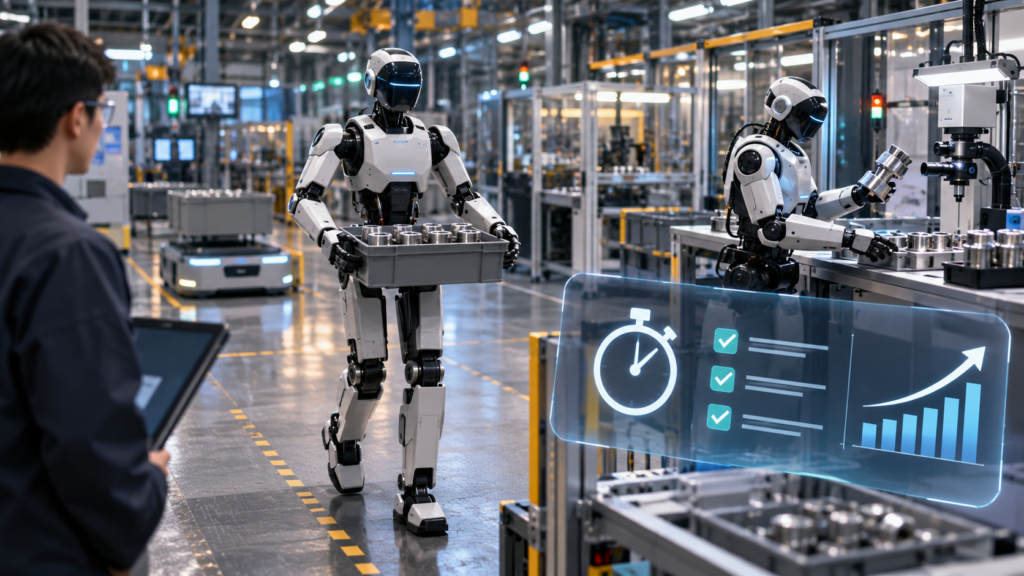
AI Robots May Soon Be Measured by Work, Not Numbers — AGIBOT Introduces “Worken”
The robotics industry has traditionally measured progress through production volumes, technical demonstrations, and the number of machines deployed.
Chinese robotics company AGIBOT is proposing a different measure: how much useful work robots actually perform.
At AGIBOT Innovation Day on October 29, 2026, the company introduced Worken, a proposed framework for evaluating productive robotic labor.
The announcement raises an important question for the emerging Agent Economy: could autonomous work eventually become a measurable economic resource?
Measuring Real Robotic Productivity
AGIBOT describes Worken as a concept combining “Work” and “Token,” representing effective intelligent work hours.
The framework considers three dimensions: autonomous operating time, the degree of independence from human intervention, and acceptable task output.
Two factories might deploy identical numbers of robots but achieve dramatically different productivity depending on how reliably those machines complete their assigned work.
Worken attempts to capture that difference.
However, it remains a company-proposed measurement framework, not an established international standard.
Source: AGIBOT Innovation Day 2026
New Robots and Embodied Intelligence
Alongside Worken, AGIBOT introduced its AHA3 humanoid hardware architecture and GO-3 Preview embodied AI model.
The company also presented G2 Max, an industrial robot designed for manufacturing and logistics operations.
According to AGIBOT, G2 Max supports dual-arm handling of up to 40 kilograms.
GO-3 Preview combines reasoning, prediction, and action to help robots adapt to changing environments.
AGIBOT reported leading results on several robotics benchmarks, although those claims require independent validation.
These developments reflect the company's emphasis on connecting robotic intelligence with sustained real-world deployment.
Source: AGIBOT Official Announcement
Emerge Times Analysis: The Economics of Autonomous Labor
The significance of Worken extends beyond robotics hardware.
Today's AI economy largely measures computational consumption through tokens, API requests, and processing time.
Physical AI introduces another possible metric: productive autonomous labor.
If robots become capable of performing repeatable industrial tasks, customers may increasingly evaluate them through completed work, operating reliability, and cost per successful task.
This could encourage business models based on measurable outcomes rather than robot ownership alone.
However, measuring productive work across different industries remains difficult. One hour of warehouse handling cannot automatically be compared with one hour of laboratory assistance.
The Bigger Picture
The Agentic Age is gradually connecting digital intelligence with physical economic activity.
AGIBOT's Worken proposal illustrates a potential transition from counting robots to evaluating their actual contributions.
Whether Worken becomes widely adopted remains uncertain.
But the underlying question is increasingly relevant:
In an economy populated by autonomous machines, what matters more — how many robots exist, or how much valuable work they deliver?
Sources
AGIBOT — Innovation Day 2026: Worken and Embodied AI, October 29, 2026
AGIBOT — GO-3 Preview and Robotics Benchmarks, November 3, 2026
This article was prepared with AI assistance and reviewed by an Emerge Times editor before publication. Licensed CC BY 4.0: credit “Emerge Times (emergetimes.com)”. Usage & License