
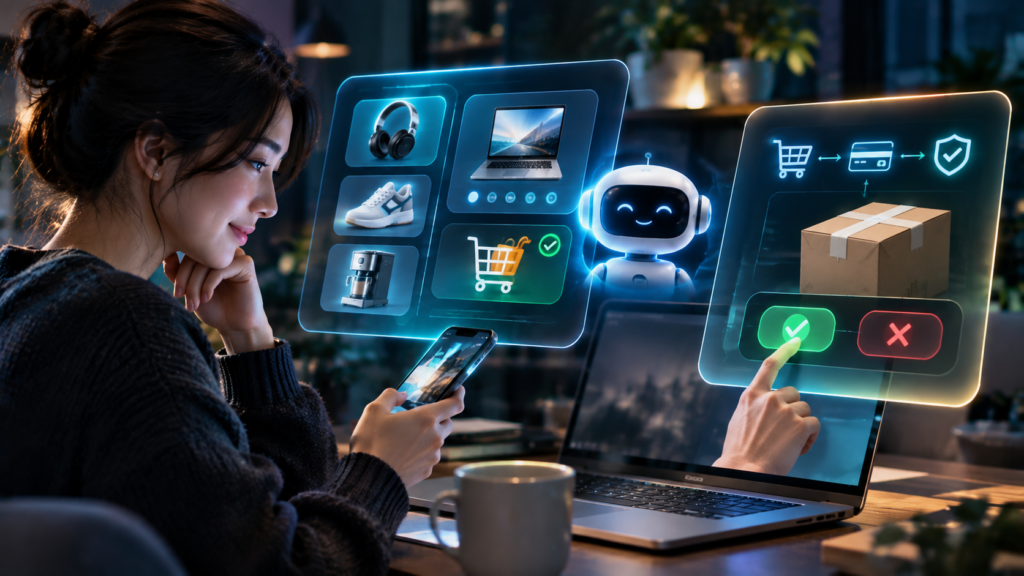
Amazon and Walmart Show AI Shopping Is Growing—But Autonomous Buying Remains Limited
Artificial intelligence is becoming a familiar part of online shopping, but consumers are not yet handing over purchasing decisions to independent AI agents at comparable scale.
Disclosures from Amazon, Walmart and DoorDash show a striking difference between using AI for shopping assistance and allowing external agents to complete transactions.
Millions Use AI Shopping Assistants
Amazon reported that more than 300 million customers used Rufus, its shopping assistant, during 2025. The company said Rufus contributed nearly $12 billion in incremental annualized sales.
Amazon renamed Rufus Alexa for Shopping in May 2026. Its capabilities include product comparisons, personalized recommendations, price monitoring, and purchases triggered by customer-defined conditions.
Amazon also offers Buy for Me, which can purchase eligible products from brand websites on customers' behalf.
Source: Amazon — Fourth Quarter 2025 Financial Results
Source: Amazon — AI Shopping Features
Walmart Reports Larger Shopping Baskets
Walmart has disclosed similarly encouraging engagement with Sparky, its consumer shopping assistant.
On its February 19 earnings call, CEO John Furner said customers using Sparky had an order value about 35% higher than those who did not use it.
Sparky helps shoppers discover products and assemble baskets that can be fulfilled through Walmart's delivery, pickup, and store networks.
However, the comparison does not prove that Sparky itself caused the higher spending.
Source: Walmart — Fourth Quarter FY2026 Earnings Call
External Agents Face a Different Reality
DoorDash presents a contrasting picture.
At the end of October, DoorDash said some of its third-party AI agent partners had generated only several hundred orders in total. CEO Tony Xu described ordering through agents as "still a very dynamic area."
These figures are not directly comparable: Amazon and Walmart measure activity within their own shopping environments, while DoorDash described orders originating from outside AI systems.
Nevertheless, the distinction is economically important.
Source: Ars Technica — DoorDash Reports Limited External Agent Orders
The Agentic Age: Assistance Before Autonomy
Consumers appear increasingly willing to use AI to compare products, discover alternatives, and prepare purchases.
Delegating payment and final transaction authority requires another level of trust.
Retailer-owned assistants benefit from established accounts, payment systems, inventory information, and customer relationships. Independent agents must connect these capabilities across platforms.
The next meaningful adoption metric is therefore not simply how many consumers talk to shopping assistants.
It is how many purchases agents complete, how often customers return, and how reliably transactions proceed without unexpected outcomes.
The consumer agent economy is expanding, but assistance and autonomous commerce remain different stages of adoption.
Sources
- Amazon — Fourth Quarter 2025 Financial Results
- Amazon — How Generative and Agentic AI Transform Shopping
- Walmart — Fourth Quarter FY2026 Earnings Call Transcript
- Ars Technica — DoorDash Reports Limited External Agent Orders, October 30, 2026
This article was prepared with AI assistance and reviewed by an Emerge Times editor before publication. Licensed CC BY 4.0: credit “Emerge Times (emergetimes.com)”. Usage & License. Featured images are AI-generated illustrations; any logos shown are trademarks of their owners, and Emerge Times is not affiliated with them.