
Google’s New Robot AI Reaches Factory Floors. The Harder Test Is Commercial Reliability.
Google DeepMind's latest robotics model has demonstrated autonomous parts handling on active Mercedes-Benz production lines. A separate warehouse deployment by GXO Logistics and Agility Robotics offers a useful comparison: the robotics industry is beginning to measure progress through completed industrial work, not just laboratory demonstrations.
FROM RESEARCH TO AUTOMOTIVE PRODUCTION
On November 10, Google DeepMind introduced Gemini Robotics 2.5, a vision-language-action model designed to improve robotic dexterity, task reliability and physical safety.
The company evaluated the model across more than 200 distinct tasks, including tool use and manipulation of delicate objects.
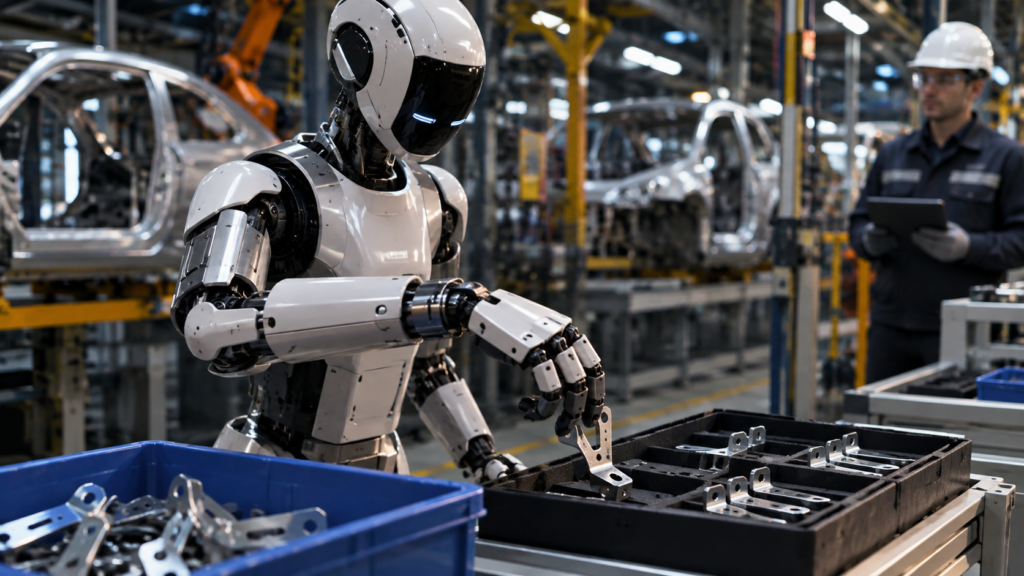
Its most commercially relevant demonstration involved Apptronik's Apollo 2 humanoid robot.
During a proof-of-concept at Mercedes-Benz facilities in Hungary and Germany, Apollo 2 autonomously sorted automotive components from bulk containers into organized trays.
Google reported a 96% success rate for this automotive kitting task.
The system combined embodied reasoning for workflow management with a robotics action model controlling physical movements.
However, the reported success rate does not establish long-term uptime, operating cost or profitability.
Source: Google DeepMind — Gemini Robotics 2.5 Accelerates Real-World General Dexterity
A DIFFERENT MEASURE OF PROGRESS
On October 26, GXO Logistics and Agility Robotics announced plans to expand their humanoid robot partnership to two additional American facilities in 2027.
Their existing Digit deployment in Georgia has moved more than 100,000 totes under a commercial arrangement that began in 2024.
Unlike Google's newly announced factory demonstration, GXO's deployment provides evidence of repeated work in an operating warehouse.
Nevertheless, the GXO and Agility Robotics announcement does not supply enough independently verified financial information to calculate a reliable return on investment.
Source: GXO and Agility Robotics — Partnership Expansion, October 26, 2026
EMERGE TIMES ANALYSIS: AUTONOMY IS NOT THE FINAL METRIC
These developments reveal two different stages of industrial robotics adoption.
Google is demonstrating increasingly capable physical intelligence across diverse tasks.
GXO is extending a narrower, established workflow into additional facilities.
The next competitive challenge is connecting those achievements.
A robot that successfully completes 96% of attempts may still require costly intervention when failures interrupt production.
Conversely, a robot performing one repetitive task reliably may deliver economic value without demonstrating broad intelligence.
Commercial success will depend on completed work per operating hour, recovery from failures, integration costs and safe collaboration with human workers.
The emerging distinction is between robots that can perform impressive tasks and robotic systems that can sustain useful work economically.
In the Agentic Age, physical intelligence will matter most when autonomy becomes measurable industrial productivity.
SOURCES
- Google DeepMind — Gemini Robotics 2.5 Accelerates Real-World General Dexterity, November 10, 2026
- GXO Logistics and Agility Robotics — Partnership Expansion, October 26, 2026
Editorial Note:
This article combines two official company announcements to develop an independent analysis. Performance and deployment figures are company-reported and have not been independently audited. Prepared with AI assistance for editorial review.
This article was prepared with AI assistance and reviewed by an Emerge Times editor before publication. Licensed CC BY 4.0: credit “Emerge Times (emergetimes.com)”. Usage & License. Featured images are AI-generated illustrations; any logos shown are trademarks of their owners, and Emerge Times is not affiliated with them.