
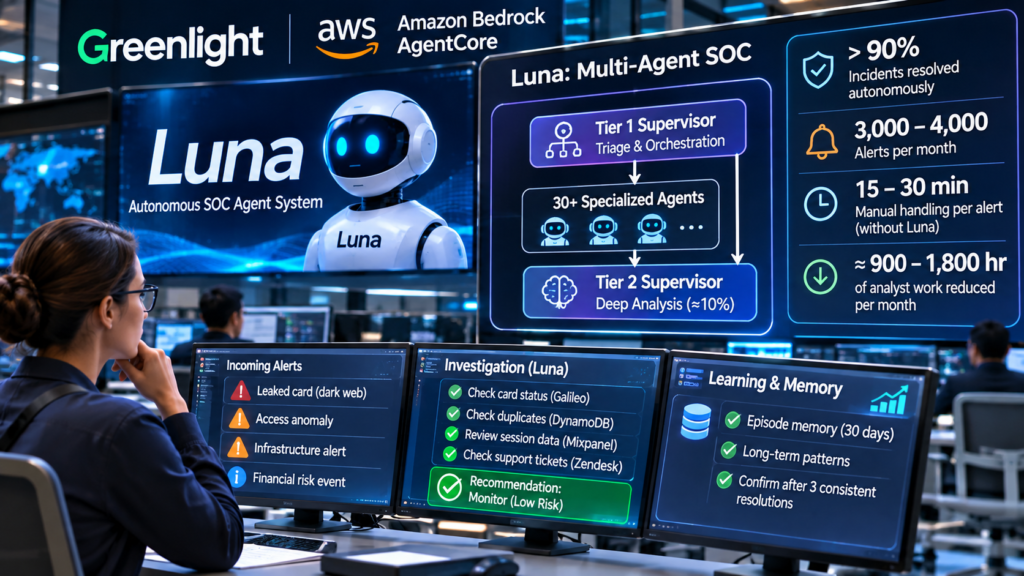
Greenlight Financial details Luna, an autonomous SOC agent system on Amazon Bedrock AgentCore
Greenlight Financial, a company offering financial products for families, has described how it built an autonomous security operations center (SOC) system called Luna on Amazon Bedrock AgentCore. In a post on the AWS machine learning blog, the company says Luna closes over 90 percent of its security and risk cases, which total as many as 4,000 a month, with no human involvement. These figures are Greenlight’s own, as relayed by AWS.
The problem: alert volume
Greenlight’s SOC receives 3,000–4,000 alerts per month from four sources: dark web breach cards, identity and access anomalies, infrastructure alerts, and financial risk events. Each alert needs checks across several data sources. For a breach-card notice, that means confirming the card is active, looking for duplicates, reviewing customer session data and checking open support tickets. The post says this takes an analyst 15–30 minutes per case.
How Luna is built
Luna is a tiered, hierarchical multi-agent system modeled on human SOC levels. A Tier 1 supervisor performs first-pass triage and coordinates more than 30 specialized agents. Cases arrive through Amazon API Gateway, which exposes a queue API and a Model Context Protocol endpoint, or through Tines SOAR. The post gives a median triage time for routine cases of single-digit seconds.
Cases that fall below Tier 1’s confidence threshold move to a Tier 2 supervisor. It uses a model with extended reasoning and takes the roughly 10 percent of cases that need multi-step analysis. It writes investigation reports with evidence chains for human review. Tier 2 runs on a schedule, and on demand for urgent escalations.
AgentCore runtime hosts the agent code, and AgentCore memory supports the learning features. According to the post, this means Greenlight does not have to build and run those capabilities itself.
Memory and the accuracy gain
Episodic memory holds recent events and outcomes over a 30-day window. Longer-term memory keeps preferences and resolution templates. One example is a weekly maintenance access pattern that Luna learned to allowlist after a single resolution. A pipeline built on AWS Lambda and DynamoDB marks a pattern as confirmed once Luna has resolved a case the same way three times.
Greenlight says this pipeline lifted the autonomous resolution rate from 83 percent with Tier 1 alone to more than 90 percent with both tiers plus the learnings.
Expansion into financial risk
Within two months of the SOC deployment, Greenlight extended Luna to financial risk triage by adding new agents and a risk-domain supervisor to the existing infrastructure. In the breach-card workflow, Luna verifies the card in Galileo and checks for duplicates in DynamoDB. It then consults Mixpanel, Zendesk and internal fraud scoring. Low-risk cases are logged and monitored, medium-risk cases are flagged for review, and high-risk cases go to analysts with a full evidence chain.
Greenlight estimates that 4,000 cases at 15–30 minutes each would take about 1,000–2,000 analyst hours a month. It says Luna avoids an estimated 900–1,800 hours of routine work.
Why it matters for agents
The post is a vendor-published case study, and the metrics have not been independently verified. Even so, several design choices are specific and reusable.
- Escalation mirrors human roles. Greenlight says the L1/L2 structure helped build trust with the security team, because it matched how they already escalate.
- Recommendation, not remediation. Luna triages and recommends. Remediation is approved and carried out either by an analyst or by an automated policy that has been signed off. Greenlight says this met its compliance requirements.
- Shared agents. Agents for Datadog, Zendesk and Mixpanel were reused in the risk domain, which the company says lowers maintenance and keeps behavior consistent.
- Learning is gated. Requiring three identical resolutions before confirming a pattern is a simple guard against learning from one-off decisions. The post does not describe how errors in learned patterns are detected.
What is next
Greenlight lists further work. Full risk-domain coverage is in progress and launched about one month before the post. It is also exploring AWS DevOps Agent for incident investigation and custom workflows, and Model Context Protocol servers for Well-Architected reviews.
Sources
- How Greenlight Financial built an autonomous SOC solution on Amazon Bedrock AgentCore — aws.amazon.com
This article was prepared with AI assistance and reviewed by an Emerge Times editor before publication. Licensed CC BY 4.0: credit “Emerge Times (emergetimes.com)”. Usage & License. Featured images are AI-generated illustrations; any logos shown are trademarks of their owners, and Emerge Times is not affiliated with them.