
Humanoid Robots Help Build Parts for Other Robots at Schaeffler’s New Taicang Facility
A new factory in China offers a glimpse of how humanoid robots could take on industrial production work, not just demonstrations.
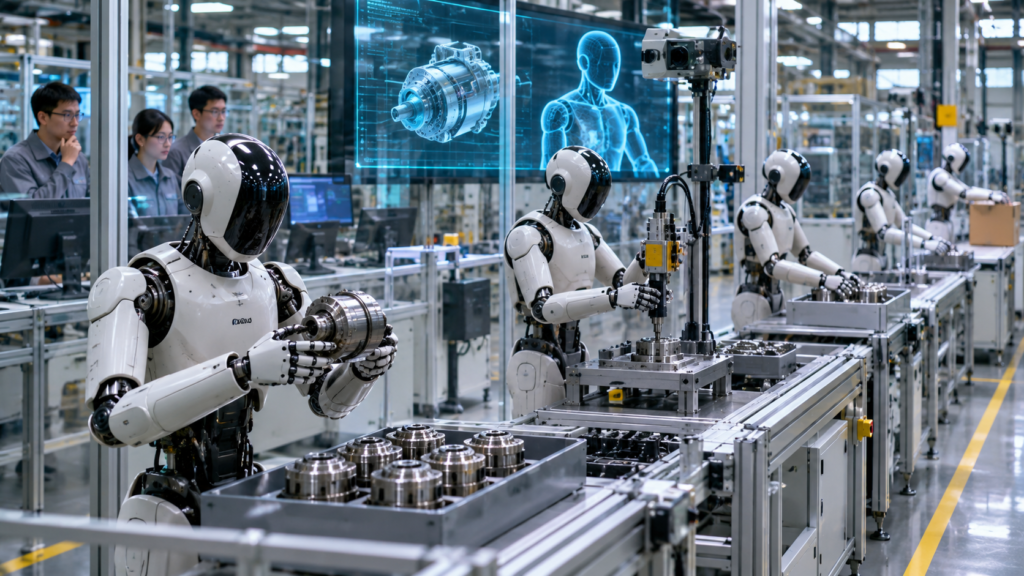
On October 20, German industrial technology company Schaeffler opened a humanoid robotics facility in Taicang, China, where humanoid machines help assemble components for the next generation of robots. According to the company, the facility combines manufacturing, robot training, data collection and digital simulation in one location.
Robots building robots
According to Schaeffler, six humanoid robots operate across five manufacturing stations. Their tasks include preparing and sorting components, assembling parts, inspecting products, and labeling and packaging. The line focuses on core robotic components, including actuators that enable mechanical movement.
Schaeffler says the facility covers about 7,500 square meters and also houses a training center and digital infrastructure for improving robot performance. Rather than demonstrating isolated movements, the robots take part in a connected industrial workflow.
The factory as a training ground
A central feature is the link between physical operations and digital twins. According to Schaeffler, sensors collect data on assembly accuracy, task duration, energy consumption and equipment condition, and engineers can test changes in simulation before introducing them into production. The company says it is also training robots for inspection, packaging, material transport and line replenishment.
Why it matters for agents
Software agents work through databases and APIs. Physical agents must also coordinate perception, movement and mechanical execution. Factories are a useful environment for developing these abilities because tasks can be measured, repeated and improved.
Deployment remains difficult.
From demonstrations to measurable work
The next milestone will not simply be building more humanoid robots. It will be showing how much useful work they complete, how often they fail, and whether their operating costs justify deployment.
The deeper change may begin when robots are judged not by how human they look, but by how reliably they help build the next generation of machines.
Sources: Schaeffler: Humanoids Making Humanoids, Lighthouse Factory in Taicang (October 20, 2026); Reuters: China's humanoid robots aren't smart enough to take your job yet (August 27, 2026)
This article was prepared with AI assistance and reviewed by an Emerge Times editor before publication. Licensed CC BY 4.0: credit “Emerge Times (emergetimes.com)”. Usage & License. Featured images are AI-generated illustrations; any logos shown are trademarks of their owners, and Emerge Times is not affiliated with them.