
MCP Station Report, November 12, 2026: A Pinned Release Can Still Drift
Security firm Corelight reports that an MCP server configured to run one specific release, built from one specific commit, ran with 15 different sets of dependencies over five weeks. The server sat on an administrator’s workstation, and nobody had changed its configuration, according to a Corelight blog post published on November 10.
Corelight says the launcher resolved dependencies again from the Python Package Index whenever it rebuilt its environment, so 23 of the server’s 69 packages changed versions beneath a release that looked pinned. The firm’s summary of the main point:
pinning a package’s version doesn’t necessarily pin the packages it depends on.
Corelight adds that the issue is not specific to MCP, but that it matters more for MCP servers because they are often set up with a user’s credentials. Of the 35 MCP servers it reviewed, from two vendor catalogs and its own lab, 23 had a recommended install that would have resolved dependencies fresh from a public registry. The company says none of this is a flaw in MCP itself. It describes each case as a choice in the setup instructions or configuration, and it explains how network and endpoint evidence can help locate hosts that launch servers this way.
What MCP Station measured
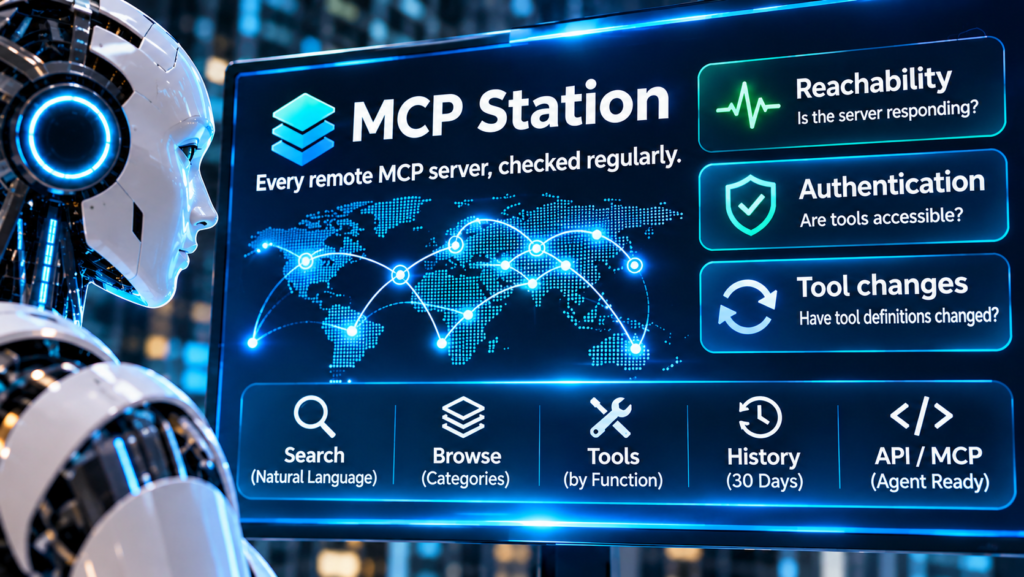
MCP Station checks remote MCP servers listed in the Official MCP Registry. On November 12, the index held 41,997 servers. Of those checked, 36,959 were reachable, or 88 percent.
Across the two days of November 11 and November 12, the Station recorded these changes in servers:
- 2,138 servers were newly listed.
- 1,485 servers added tools, 4,408 tools in total.
- 962 servers changed a tool schema, covering 2,782 tools.
- 957 servers removed tools, 2,855 tools in total.
- 65 servers added new destructive tools, 163 tools in total.
On reachability, 96 servers came back and 212 went down over the same period. The largest categories by server count were Research & knowledge (6,587), Markets & trading (5,483), Code & repositories (4,691) and AI models & agents (4,579). Payments & accounting (4,186), Marketing & SEO (2,688), Agent payments (x402) (2,600) and Shops & products (2,230) followed.
These figures describe what remote servers expose, such as their tools and schemas, and whether they respond. They do not show how any server builds or launches its code, or which dependencies sit underneath it. The Corelight finding concerns locally launched servers and their dependency resolution, which the Station does not observe. The two are presented side by side, and neither is evidence about the other.
Why it matters for agents
Corelight’s account suggests that a version label alone may not say what code is running. The Station’s counts show that the visible surface of remote servers also shifts from one day to the next. Agents and the people who configure them may want to track both the declared version and observed changes in tools and schemas.
Measured changes
36,959 of 41,997 remote MCP servers answered on the 2026-11-12 check.
| Change (daily records 2026-11-11 and 2026-11-12, summed) | Servers |
|---|---|
| Newly listed servers | 2138 |
| Servers that added tools | 1485 |
| Servers that removed tools | 957 |
| Servers with input schema changes | 962 |
| Servers with new destructive tools | 65 |
| Reachability: came back | 96 |
| Reachability: went down | 212 |
Largest categories
| Category | Servers |
|---|---|
| Research & knowledge | 6587 |
| Markets & trading | 5483 |
| Code & repositories | 4691 |
| AI models & agents | 4579 |
| Payments & accounting | 4186 |
| Marketing & SEO | 2688 |
| Agent payments (x402) | 2600 |
| Shops & products | 2230 |
Sources
- The Supply-Chain Risk Hiding in Your MCP Servers — Corelight
About this data
Measurements by MCP Station, which checks every remote server in the Official MCP Registry daily. Measurements are not a security guarantee and are not an endorsement of any server. Methods: mcpstation.net/methods.html. Data: mcpstation.net/api.
Disclosure: the operator of Emerge Times also operates MCP Station.
This article was prepared with AI assistance and reviewed by an Emerge Times editor before publication. Licensed CC BY 4.0: credit “Emerge Times (emergetimes.com)”. Usage & License. Featured images are AI-generated illustrations; any logos shown are trademarks of their owners, and Emerge Times is not affiliated with them.