
MCP Station Report, November 17, 2026: Governed Tool Gateways and a Day of Registry Change
An InfoQ article published on November 16, 2026 describes how an agentic operations platform can run in a regulated utility environment. The design keeps reasoning separate from execution. Agents correlate signals, assess business impact and propose remediation. Every production action must then cross a deterministic policy boundary that the model cannot override.
According to InfoQ, the boundary is defined outside the model. Each proposed action maps to a risk class and an approval requirement in a versioned action catalog. A governed tool gateway is the only path from an agent proposal to a production change. The article says Model Context Protocol (MCP) is used at the tool boundary to standardize how tools are described and invoked. That gives the platform one place to constrain operations, validate arguments, enforce policy and record evidence.
The article also says autonomy is earned. The platform starts read-only and expands one action class at a time. It can revoke that autonomy as easily as it grants it. InfoQ’s summary of the principle:
The model can propose anything. It can execute only what the policy gate authorizes.
What MCP Station measured
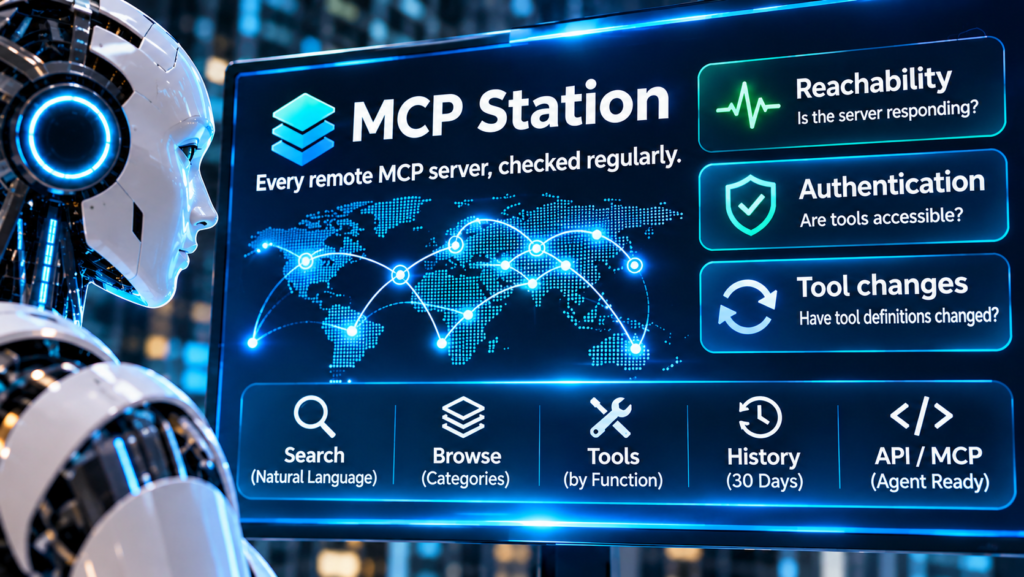
MCP Station checked the remote servers in the Official MCP Registry on November 17, 2026. The index held 41,989 servers. Of those, 39,262 were reachable, about 94 percent.
In MCP Station’s daily records for November 16 and 17, summed, 2,911 servers had input schema changes. In the same records, 2,408 servers were newly listed. Tools were added on 677 servers, 2,583 tools in total. Tools were removed on 130 servers, 916 tools in total.
Among the additions, 118 servers gained new tools classed as destructive, 224 tools in total. For reachability, 257 servers went down and 120 came back.
The largest categories by server count were Research & knowledge (6,551), Markets & trading (5,548), Code & repositories (4,690), AI models & agents (4,425) and Payments & accounting (4,270). Marketing & SEO (2,785), Agent payments (x402) (2,409) and Shops & products (2,260) followed.
These figures sit beside the InfoQ article. They are context only. The article describes one organization’s design, and the station data describes the wider registry. Neither is presented as causing the other.
Why it matters for agents
InfoQ’s pattern relies on a schema-defined tool boundary and on a versioned action catalog that, the article says, makes approval decisions “predictable, testable, and reviewable”. The station data shows that tool definitions on remote servers change often, and that some servers drop out of reach and others return. An agent that connects to such servers has to cope with those changes. A versioned action catalog and a single policy-enforcing gateway are one way to handle them.
Measured changes
39,262 of 41,989 remote MCP servers answered on the 2026-11-17 check.
| Change (daily records 2026-11-16 and 2026-11-17, summed) | Servers |
|---|---|
| Newly listed servers | 2408 |
| Servers that added tools | 677 |
| Servers that removed tools | 130 |
| Servers with input schema changes | 2911 |
| Servers with new destructive tools | 118 |
| Reachability: came back | 120 |
| Reachability: went down | 257 |
Largest categories
| Category | Servers |
|---|---|
| Research & knowledge | 6551 |
| Markets & trading | 5548 |
| Code & repositories | 4690 |
| AI models & agents | 4425 |
| Payments & accounting | 4270 |
| Marketing & SEO | 2785 |
| Agent payments (x402) | 2409 |
| Shops & products | 2260 |
Sources
About this data
Measurements by MCP Station, which checks every remote server in the Official MCP Registry daily. Measurements are not a security guarantee and are not an endorsement of any server. Methods: mcpstation.net/methods.html. Data: mcpstation.net/api.
Disclosure: the operator of Emerge Times also operates MCP Station.
This article was prepared with AI assistance and reviewed by an Emerge Times editor before publication. Licensed CC BY 4.0: credit “Emerge Times (emergetimes.com)”. Usage & License. Featured images are AI-generated illustrations; any logos shown are trademarks of their owners, and Emerge Times is not affiliated with them.