
Telecom AI Agents Move Beyond Chat: U Mobile and PLDT Show Real Operational Work
AI agents are beginning to move beyond answering customer questions into diagnosing service failures and coordinating operational fixes. Two telecommunications deployments in Southeast Asia illustrate that transition, while revealing an important boundary: autonomous investigation does not always mean autonomous execution.
U MOBILE: EIGHT AGENTS IN PRODUCTION
In a November 4 AWS case study, Malaysia's U Mobile described AiDaH, an agentic operations system deployed to 50 second-level support and branch employees during the third quarter of 2026.
The system operates eight agents and covers more than 150 documented operational scenarios.
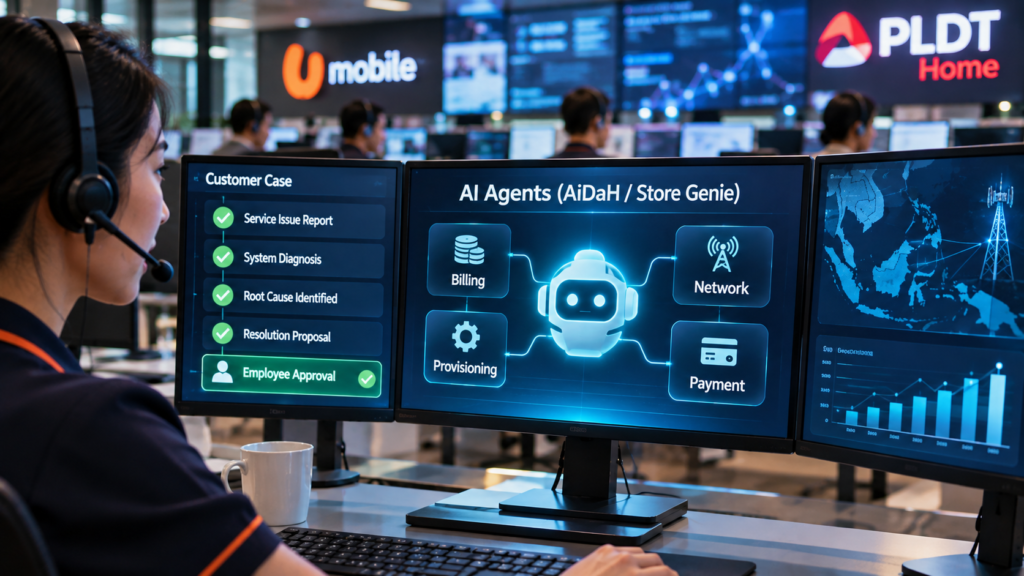
When a customer cannot use mobile data overseas, AiDaH checks roaming settings, eligibility and possible failure points. It then proposes corrective actions for employee approval.
In one documented incident, a subscriber attempted to purchase a mobile data add-on more than 30 times over three days. The system identified a pending order that prevented the transactions and presented the underlying cause and remediation steps.
The example demonstrates investigation across operational systems, rather than merely generating a customer-service response.
Source: AWS — How U Mobile Built Agentic Telco Operations with Amazon Bedrock AgentCore
PLDT: MEASURABLE CUSTOMER-SERVICE ACTIVITY
A separate deployment announced by Amdocs in June provides a broader operational comparison.
Its Store Genie platform launched at Smart Communications in March and was later extended to PLDT Home in the Philippines. Across both units, it reportedly supported more than 750 frontline agents at 149 locations.
Since the March launch, Amdocs reported over 44,000 customer inquiries resolved through AI agents and more than 61,000 hours of customer waiting time avoided across both units.
The system connects specialized billing, provisioning, network and payment agents to existing business systems through Amazon Bedrock AgentCore Gateway.
At PLDT Home, Amdocs reported that certain workflows, such as order inquiries, fell from hours to about two minutes.
These figures are vendor-reported and lack independently published measurement methodology.
Source: Amdocs — Amdocs Expands Store Genie to PLDT Home, June 23, 2026
EMERGE TIMES ANALYSIS: THE NEW UNIT OF AUTOMATION
Together, these deployments suggest that the meaningful unit of agentic automation is shifting from the conversation to the operational workflow.
A chatbot answers a question. An operational agent identifies the relevant account, investigates connected systems and prepares or executes a corrective action.
That distinction matters economically because customer-service costs frequently arise from investigation, coordination and repeated contacts rather than conversation alone.
Yet the deployments establish different levels of autonomy.
U Mobile explicitly preserves human approval before changes to subscriber accounts. PLDT reports substantial automated resolution activity, but its announcement does not fully separate autonomous execution from employee-assisted completion.
The next benchmark should therefore measure completed tasks, human interventions, error rates and repeat contacts—not merely the number of agents deployed.
The Agentic Age will be defined less by how convincingly machines communicate than by how reliably they finish authorized work.
Sources
- AWS — How U Mobile Built Agentic Telco Operations with Amazon Bedrock AgentCore, November 4, 2026
- Amdocs — Amdocs Expands Store Genie to PLDT Home, June 23, 2026
Editorial Note: Operational results are company-reported and have not been independently audited.
This article was prepared with AI assistance and reviewed by an Emerge Times editor before publication. Licensed CC BY 4.0: credit “Emerge Times (emergetimes.com)”. Usage & License. Featured images are AI-generated illustrations; any logos shown are trademarks of their owners, and Emerge Times is not affiliated with them.