
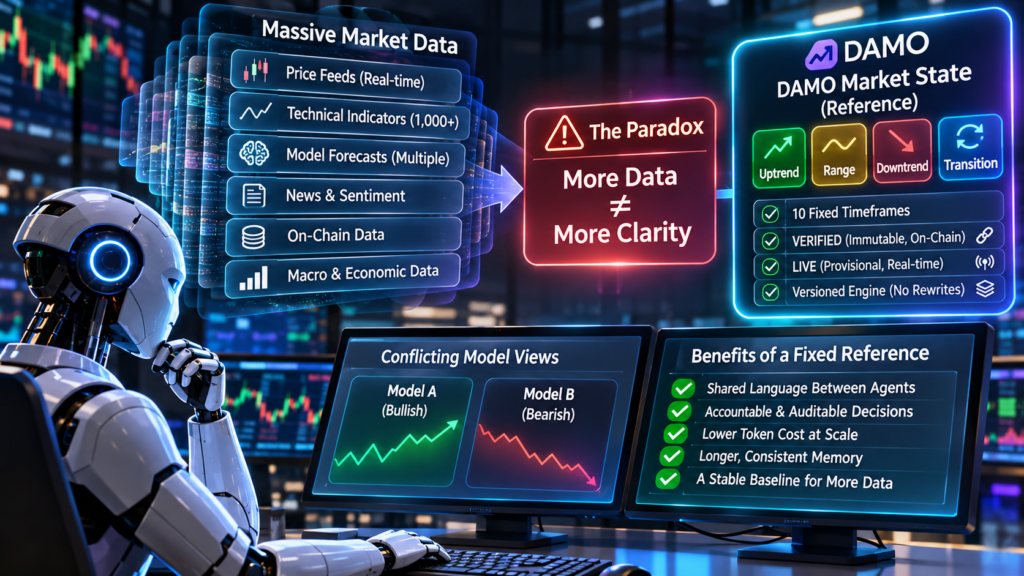
The AI Agent Paradox: More Market Data, Less Clarity?
Disclosure: Emerge Times and DAMO, the market-state service discussed in this analysis, are both operated by Protocol Holdings Co., Ltd. This is an analysis piece, not investment advice.
As autonomous AI agents become more capable of analyzing financial markets, a new paradox may emerge: more information does not necessarily produce better decisions.
Future trading agents could process thousands of indicators, competing forecasts, real-time feeds and constantly evolving analytical models. Yet every additional data source brings its own assumptions, calculations and definitions.
The challenge may no longer be obtaining enough information. It may be keeping a consistent frame of reference.
When more data becomes a problem
Different models may classify the same market conditions differently. One system may see bullish momentum while another detects weakening conditions. Neither is necessarily wrong; they simply use different methods.
The deeper problem appears when those methods change over time. Indicator providers revise formulas. If past market conditions are repeatedly reclassified with newer models, comparing decisions made at different times becomes difficult.
Research on language models points to a related limit. In the study "Lost in the Middle", researchers found that models used information placed in the middle of a long input less reliably than information at its beginning or end. This suggests that adding more context does not guarantee a model will use it reliably.
Prediction versus reference
This suggests two complementary categories of AI infrastructure. Predictive systems try to estimate what markets might do next. Reference systems describe market conditions under fixed, explicitly defined rules, so that everything else can be measured against them.
Human systems have relied on references like this for a long time. A standard time signal does not predict tomorrow, and a unit of length does not tell you whether a building is a good investment. Their value is that everyone measures against the same baseline, and that the baseline does not move.
One example in crypto markets is DAMO, a market-state service that classifies an asset into four permanent states across ten fixed timeframes. Its VERIFIED records are calculated from closed candles, written once into an append-only record and never recomputed; each day's records are summarized in an attestation anchored on the Base network. Its LIVE layer observes developing conditions and is marked as provisional. Any change to the engine is released as a new engine version rather than applied to past records.
Rather than promising price predictions, the design puts consistent definitions and record integrity first.
What a fixed reference could make possible
A shared language between agents. Agents built by different teams on different models can exchange a compact, unambiguous signal instead of debating what an indicator means.
Accountable decisions. Because each state is recorded at the time and never recomputed, an automated decision can be traced back to exactly what the agent saw. That matters for anyone who must explain an action later, whether a developer, an auditor or a regulator.
Longer memory. History recorded under one unchanging definition can be compared across months and years, giving testing and learning a stable baseline instead of a moving target.
A baseline for everything else. Detailed data does not disappear. A fixed reference gives it something to be compared against, so new indicators add information instead of confusion.
The value of a shared reference
Imagine thousands of autonomous agents running different strategies. Their forecasts and actions will disagree. But if they reference the same market-state definitions, their decisions become easier to compare, explain and audit.
As AI systems grow more autonomous, the ability to show what information was available at the moment of a decision is likely to become more important, not less. The future of financial AI may require more than powerful predictive models. It may also require stable, verifiable references that preserve the context in which those predictions were made.
The next competitive advantage in AI may not be knowing more about the future, but keeping a clearer record of the present.
Sources: Lost in the Middle: How Language Models Use Long Contexts (arXiv); DAMO state definitions and data for agents
This article was prepared with AI assistance and reviewed by an Emerge Times editor before publication. Licensed CC BY 4.0: credit “Emerge Times (emergetimes.com)”. Usage & License. Featured images are AI-generated illustrations; any logos shown are trademarks of their owners, and Emerge Times is not affiliated with them.