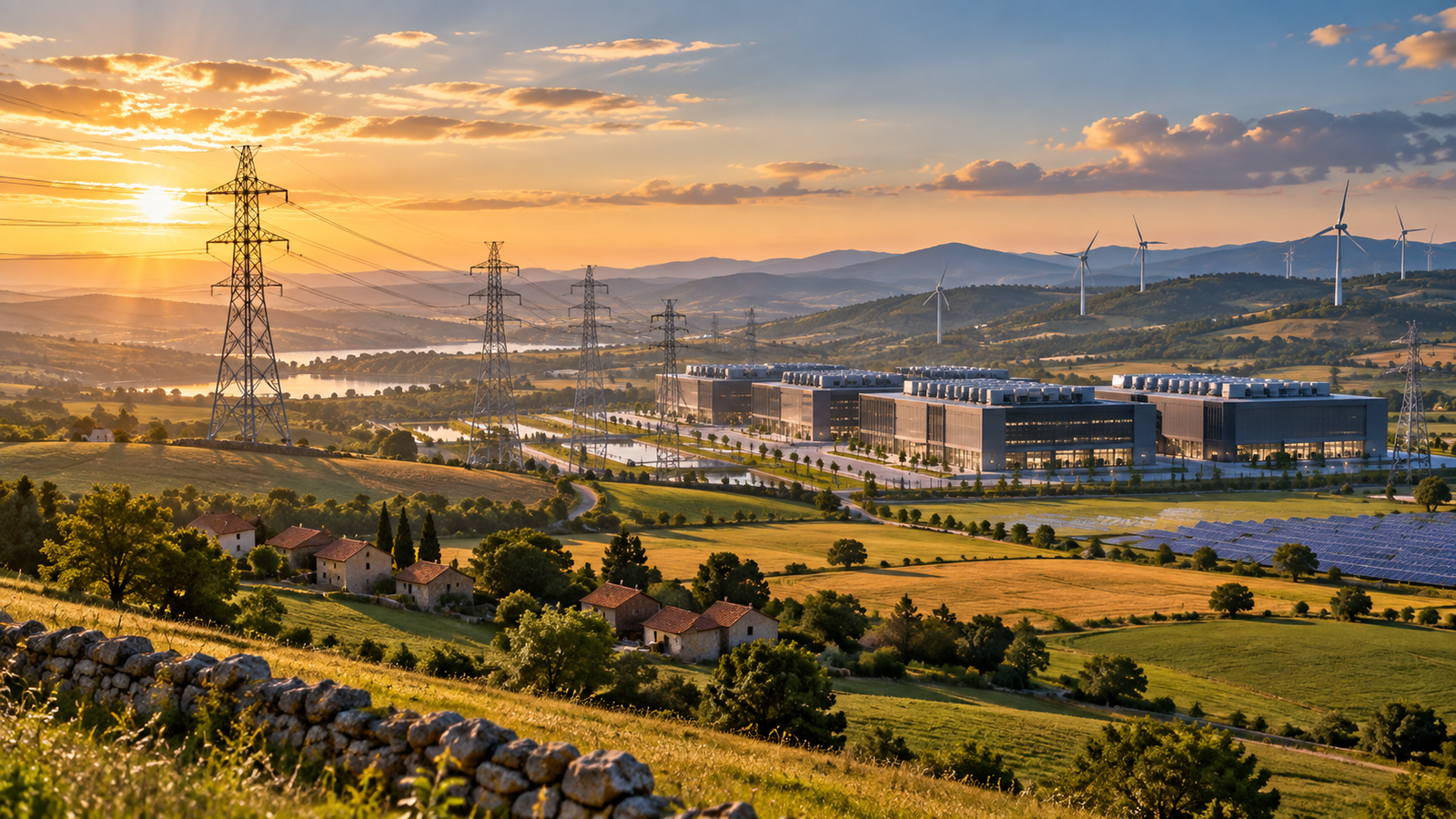
Artificial intelligence is usually discussed as a story of chips, algorithms and data centers. But the AI boom is increasingly becoming a story about something far more physical: electricity, infrastructure — and land.
Across Europe, the rapid expansion of computing infrastructure is beginning to collide with the limits of the power grid. That collision could gradually change which locations are considered valuable in the AI economy.
And that raises a question that has received surprisingly little attention:
Could the AI boom eventually reshape the economic value of parts of rural Europe?
AI Has a Physical Footprint
AI may live in the cloud, but the cloud lives somewhere.
Training and operating increasingly powerful AI systems requires enormous computing infrastructure. Those computers sit inside data centers that require electricity, cooling systems, fiber connections and physical land.
According to the International Energy Agency, data centers consumed about 415 terawatt-hours of electricity worldwide in 2024.
By 2030, that figure is projected to rise to around 945 TWh — more than double today’s level.
Europe is part of that expansion.
The IEA projects that European data-center electricity consumption will increase by more than 70 percent between 2024 and 2030.
Meanwhile, the European Union wants to substantially expand its computing infrastructure, with a goal of tripling data-center capacity by 2035.
AI, in other words, is no longer only a software story.
It is becoming an infrastructure story.
Europe Is Running Into the Grid
For decades, Europe’s data-center industry has concentrated around a handful of major hubs, including Frankfurt, London, Amsterdam, Paris and Dublin.
These locations offered connectivity, customers, infrastructure and established technology ecosystems.
But the AI boom introduces a new constraint: power.
Large data centers can require electricity on the scale of major industrial facilities, while electricity grids take years to expand.
In some established European data-center markets, developers are already encountering long waits for grid connections.
That creates an unusual situation.
A location close to a major technology center may have excellent digital infrastructure — but limited access to additional electricity.
Meanwhile, another location hundreds of kilometers away may have abundant renewable generation, available grid capacity and cheaper land.
Suddenly, geography begins to matter differently.
From AI to Land
Follow the AI value chain backward and an interesting pattern appears.
AI requires computing.
Computing requires data centers.
Data centers require electricity.
Electricity requires generation and grid infrastructure.
And all of those ultimately require physical locations.
AI → Compute → Data Centers → Electricity → Grid → Land
This chain could create a new way of thinking about land value.
For much of the modern economy, rural land has been valued primarily according to agriculture, housing, tourism, natural resources or proximity to cities.
The AI infrastructure economy may introduce another variable:
access to power.
Land near strong transmission infrastructure, renewable-energy generation, fiber networks and suitable development zones could acquire strategic characteristics that were previously less important.
Not Every Rural Area Will Benefit
This does not mean rural land across Europe is about to surge in value.
Far from it.
A remote field with no grid capacity or fiber connection has little relevance to a hyperscale data center.
The emerging premium, if it develops, is likely to be highly selective.
The most interesting locations could be those where several conditions overlap:
abundant electricity,
strong grid connections,
renewable-energy resources,
fiber connectivity,
sufficient land,
cooling availability,
supportive permitting,
and access to skilled workers.
That combination is rare.
And rarity is precisely what could make certain locations strategically valuable.
The Geography of Computing May Be Changing
Evidence of this shift is beginning to appear.
Energy think tank Ember has warned that grid constraints could change the geography of European data centers.
Developers increasingly have an incentive to consider markets where electricity connections can be secured faster rather than simply following the industry’s traditional geographic centers.
If that continues, the European data-center map of the 2030s may look very different from the map of the 2020s.
This would have consequences beyond technology companies.
New data centers require substations, transmission infrastructure, construction, fiber networks, energy generation and supporting services.
Infrastructure investment tends to create secondary economic effects around it.
The important question may therefore not be simply:
“Where will the next data center be built?”
A more revealing question