
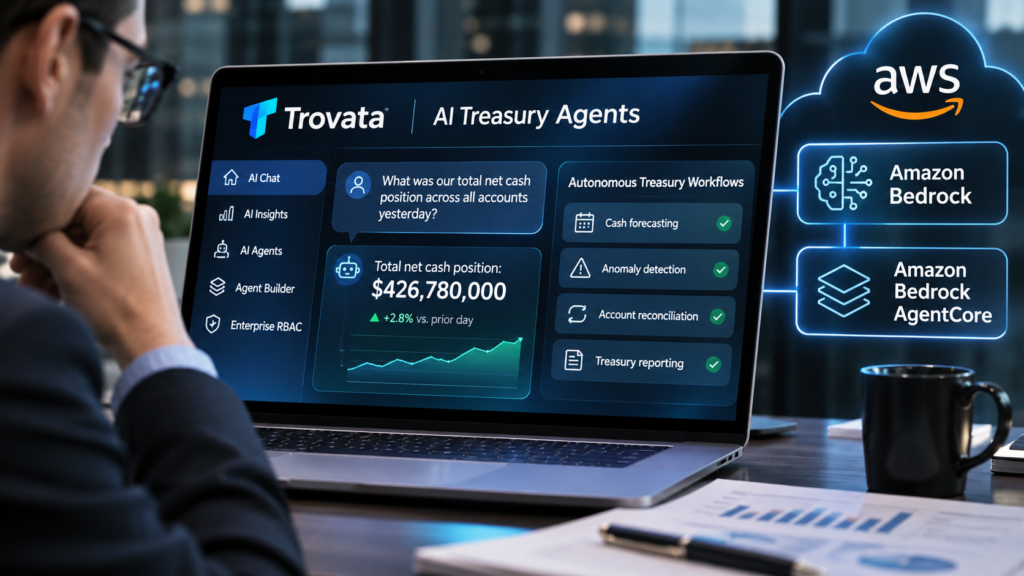
Trovata details treasury agents running on Amazon Bedrock AgentCore
An AWS machine-learning blog post dated 10 November 2026 explains how Trovata, a cash and liquidity management platform, uses Amazon Bedrock and Amazon Bedrock AgentCore for its treasury agents. Trovata says it connects directly to over 10,000 banks. According to the post, it now deploys agents that act for treasury teams, where before it mainly supplied insights.
What Trovata built
The post names three pain points for treasury teams: banking data scattered across many portals, reporting and reconciliation done by hand, and older treasury management systems (TMS) without cloud-native design or AI. Trovata introduced a generative AI product for treasury in 2023. The post says it has since shifted to persistent agentic workflows.
The architecture is described in five parts:
- AI Chat: plain-English questions over data from multiple banks, for example asking what the net cash position was across all accounts yesterday.
- AI Insights: proactive detection of anomalies, explanations of variances and analysis of trends.
- AI Agents: workflows triggered by schedules, events or rules that send updates with no human involved.
- Agent Builder-Configurator: a console where teams create agents and define what they cover.
- Enterprise RBAC: role-based access control that keeps agents inside the same permission limits as human users.
The post says Amazon Bedrock provides the language-model inference. AgentCore covers orchestration, access control and deployment, and serverless AWS infrastructure supports real-time execution.
Security and deployment model
Per the post, the AI gets data only through Trovata’s own verified API layer and never touches databases directly. Agents execute in an isolated AgentCore runtime, and both AI queries and agent actions are recorded for compliance review.
Banks can put the agents inside their own branded applications. The post frames this as a route for banks to offer AI treasury tools without developing AI themselves.
The use cases it lists include cash forecasting with scenario modeling, natural-language queries, anomaly detection, and reconciliation summaries across hundreds of accounts. Trovata’s AI Agents Playbook contains ten agent patterns taken from real customer deployments. The post asserts that most treasury teams have 5–15 workflows suited to agents today.
Reported results
The post credits Trovata’s customers with these outcomes:
- Annualized cost savings above $1M.
- More than 5 hours saved each day per accounting team.
- A 77 percent drop in yearly TMS spending.
- Treasury reports produced in under a minute, versus hours or days earlier.
The post does not explain how many customers these numbers cover or how they were measured. It also gives no count of agents in production. It says Trovata intends to add agent patterns, deepen ERP integrations and widen global bank connectivity.
Why it matters for agents
This is a vendor-written case study on AWS’s own blog, so the outcome figures are better treated as claims than as independent findings. Still, the design points to patterns other agent builders may borrow.
- Agents inherit human permissions. Binding agent actions to the same role boundaries as people is a practical way to contain risk in a regulated field like finance.
- Data access is mediated by an API. Denying direct database access creates one place to enforce rules and capture audit logs.
- Distribution through intermediaries. The bank-branded approach suggests software vendors may embed agents in vertical SaaS and let institutions present them under their own name. The post says AgentCore allows independent software vendors to do this with governed agents.
One point is unclear. The post describes money movement as a platform capability, but it does not say whether agents can start payments or only monitor, analyze and report. The agent tasks it lists are monitoring, variance explanation, anomaly detection and updates. That difference will matter to anyone judging how autonomous these agents really are.
Sources
- Autonomous treasury agents: How Trovata built an AI-native solution on Amazon Bedrock and AgentCore — aws.amazon.com
This article was prepared with AI assistance and reviewed by an Emerge Times editor before publication. Licensed CC BY 4.0: credit “Emerge Times (emergetimes.com)”. Usage & License. Featured images are AI-generated illustrations; any logos shown are trademarks of their owners, and Emerge Times is not affiliated with them.