
AWS updates AgentCore runtime with faster starts, larger sessions and usage-based memory billing
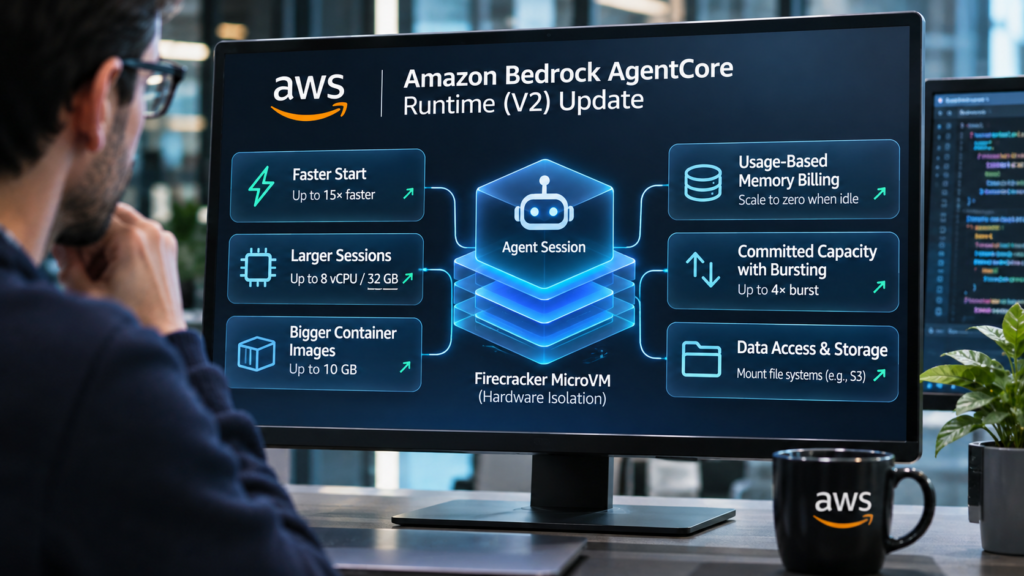
Amazon Web Services published updates to the AgentCore runtime, a part of Amazon Bedrock AgentCore, in a blog post dated 12 November 2026. The November post adds sessions of up to 8 vCPUs and 32 GB of memory, a committed baseline with bursting of up to four times that level, container images of up to 10 GB, and expanded regions. AWS claims startup is up to 15x quicker, the compute ceiling is 4x higher, and efficiency gains reach 68%. The isolation model is unchanged: every session gets a dedicated Firecracker MicroVM backed by hardware isolation, plus its own identity, policy and audit records. All performance figures in this article are AWS’s own claims.
What changed
A session can now use up to 8 vCPUs and 32 GB of memory, and container images can reach 10 GB. AWS says sessions begin in under 2 seconds whatever the image size or the number of concurrent sessions. According to the company, teams no longer have to keep spare capacity ready in advance to avoid cold starts.
Billing has changed too. Memory is reclaimed within minutes once an agent lets go of it, and an idle agent scales down to zero. AWS says multi-turn agents that pause between interactions can consume up to 68 percent less memory per session. For always-on agents, a committed baseline option sets a minimum billed memory level per session, with on-demand bursting to four times that level. This is priced at AWS Lambda MicroVM rates, which AWS says gives stable workloads a predictable cost.
The third change concerns data. Agents can now mount a filesystem on the fly and save their work to it, for instance an Amazon S3 bucket with FUSE support. AWS says this keeps data within the trust boundary for the whole job, governed by one set of controls. According to AWS’s release notes, FUSE filesystem mounts and per-session data access restrictions (session context keys), which restrict sessions to their own data, were already available in V2 in October 2026. AWS says limiting each session to a dedicated storage folder using session-labeled credentials will arrive by re:Invent.
Customer reports
The post includes testimonials selected by AWS. Mission Cloud described an initial comparison of the two runtime versions: 35% faster cold starts for inference requests, 77% faster starts for health checks, and 17% lower measured runtime cost per call. Zuora said memory use per invocation dropped by around 60% in many use cases while the system handled more traffic at steady latency. Coinbase, Okta, Deloitte Consulting, Cox Automotive and Thomson Reuters also offered supportive comments, which contain no measurements.
“Each coding agent session runs in its own hardware-isolated environment,” said Siwei Shen, VP of Engineering at Coinbase.
Context cited by AWS
AWS places the release against several outside figures. It cites METR for the idea that the length of task leading agents can finish autonomously roughly doubles every four months. It cites McKinsey for 40 percent of large enterprises scaling AI agents, up from 27 percent a year earlier. It cites Deloitte for only 15 percent of organizations having scaled orchestrated multi-agent systems and 70 percent saying they cannot yet trust and govern their agents.
The new runtime is offered today across regions in North America, South America, Europe and Asia Pacific. According to AWS’s release notes, V2 had expanded by November to several regions, including Seoul. The source gives no prices.
Why it matters for agents
The update targets two familiar obstacles for production agents: the trade-off between startup delay and paying for idle capacity, and data that lives outside the isolation boundary. If the sub-2-second starts hold under real load, some teams may be able to retire custom setups built to hide cold starts. Billing that follows memory actually in use also fits how agents spend much of their time waiting on models, tools or people.
Caution is warranted. The performance and efficiency numbers come from AWS and hand-picked customers, and the source does not describe how they were measured. The “up to” figures are best cases. Teams should test their own workloads before relying on the cost and latency claims.
Sources
- Run agents securely and efficiently with the next generation AgentCore runtime — aws.amazon.com
- Amazon Bedrock AgentCore release notes — docs.aws.amazon.com
This article was prepared with AI assistance and reviewed by an Emerge Times editor before publication. Licensed CC BY 4.0: credit “Emerge Times (emergetimes.com)”. Usage & License. Featured images are AI-generated illustrations; any logos shown are trademarks of their owners, and Emerge Times is not affiliated with them.