
Serve Robotics Opens Delivery Robots to AI Agents, but Real-World Access Still Has Limits
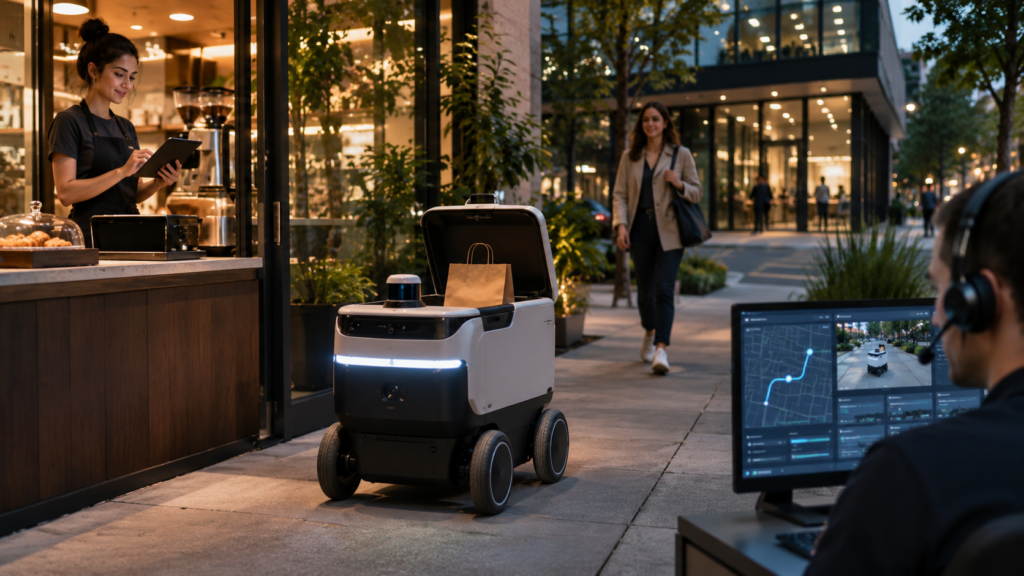
AI assistants can now be connected to a real-world delivery network through a public developer interface. Serve Robotics has introduced an API and testing sandbox for its autonomous sidewalk robots, creating a potential bridge between software agents and physical services without requiring developers to build their own machines.
A ROBOT FLEET BECOMES AN API
On November 11, Serve Robotics announced its AV Delivery Developer Portal, allowing applications, businesses and AI assistants to request deliveries.
Developers specify pickup and drop-off locations, confirm delivery details and track progress. Serve retains responsibility for dispatch, navigation, routing and remote supervision.
The company reports more than 2,000 robots deployed cumulatively and hundreds of thousands of deliveries completed across over 150 neighborhoods in 20 US cities.
These figures describe the existing network, not the number of robots simultaneously operating or deliveries completed through the newly launched API.
The portal includes a sandbox with simulated robots where developers can test the full delivery workflow and rehearse edge cases before using a real robot.
Live robot access requires Serve's approval and remains limited by service coverage, operating hours and cargo capacity.
Source: Serve Robotics, November 11, 2026
TWO LAYERS OF PHYSICAL AI
The announcement follows Serve's November 5 introduction of Physical AI Services.
That separate offering provides connectivity, data-curation tools and real-world training data to robotics developers. Bedrock Robotics, which develops autonomous construction equipment, was named among its initial customers.
The two announcements represent different layers: one helps other companies develop and operate intelligent machines; the other lets software applications request physical delivery services.
Source: Serve Robotics, November 5, 2026
EMERGE TIMES ANALYSIS: THE PHYSICAL API ECONOMY
The important innovation is not a new robot movement. It is the abstraction of a physical task into a software request.
An AI purchasing assistant could eventually arrange delivery after completing an authorized transaction. An office agent could request movement of supplies between buildings.
However, a successful API response is not proof of a successful physical delivery.
Real-world operations still depend on availability, safe navigation, human supervision, correct addresses and recovery when deliveries fail.
Commercial viability will require evidence of completed deliveries, intervention rates, delivery costs and fleet utilization.
Opening the network could improve demand beyond traditional meal-delivery peaks, but the company has not independently demonstrated those economic benefits for third-party developers.
The Agentic Age may increasingly connect digital decision-making with physical execution through APIs.
The decisive benchmark will be whether these integrations reliably complete authorized tasks, not merely whether an AI agent can summon a robot.
Sources
- Serve Robotics — Serve Robotics Opens Its Robot Delivery Network for Anyone to Build On, November 11, 2026
- Serve Robotics — Serve Robotics Launches Physical AI Services, November 5, 2026
Editorial Note: Fleet and delivery figures are company-reported. The new API's independent commercial performance has not yet been established. Both sources originate from Serve Robotics and do not constitute independent cross-verification.
This article was prepared with AI assistance and reviewed by an Emerge Times editor before publication. Licensed CC BY 4.0: credit “Emerge Times (emergetimes.com)”. Usage & License. Featured images are AI-generated illustrations; any logos shown are trademarks of their owners, and Emerge Times is not affiliated with them.